


Last Updated: November 4, 2026
Quick Summary
Yes, EVO ICL reversible vision correction means the implantable Collamer lens can be removed or exchanged by a surgeon if your prescription changes later. Removal is a surgical procedure, not an office visit, and it brings vision back toward your original prescription rather than resetting the eye to its pre-surgery state.
- The EVO ICL sits behind the iris and in front of your natural lens, with no corneal tissue removed or reshaped.
- LASIK permanently reshapes corneal tissue, while EVO ICL leaves the cornea intact and adds a lens instead.
- Presbyopia begins around the mid-40s, and EVO ICL does not stop this age-related near vision change.
- Cataract surgery remains available after EVO ICL, and the ICL is removed as part of that planning.
- Endothelial cell density is a key metric monitored over time because the ICL sits close to the cornea.
Table of Contents
- What Reversible Actually Means for EVO ICL
- What Lens Removal Can and Cannot Restore
- EVO ICL vs LASIK: How the Reversibility Gap Works
- Age-Related Vision Changes and Your Prescription
- Cataract Surgery After ICL: What Your Future Options Look Like
- Long-Term Effects of EVO ICL and the Limits of Safety Data
- Schedule a Consultation to Review Your Candidacy
- Frequently Asked Questions
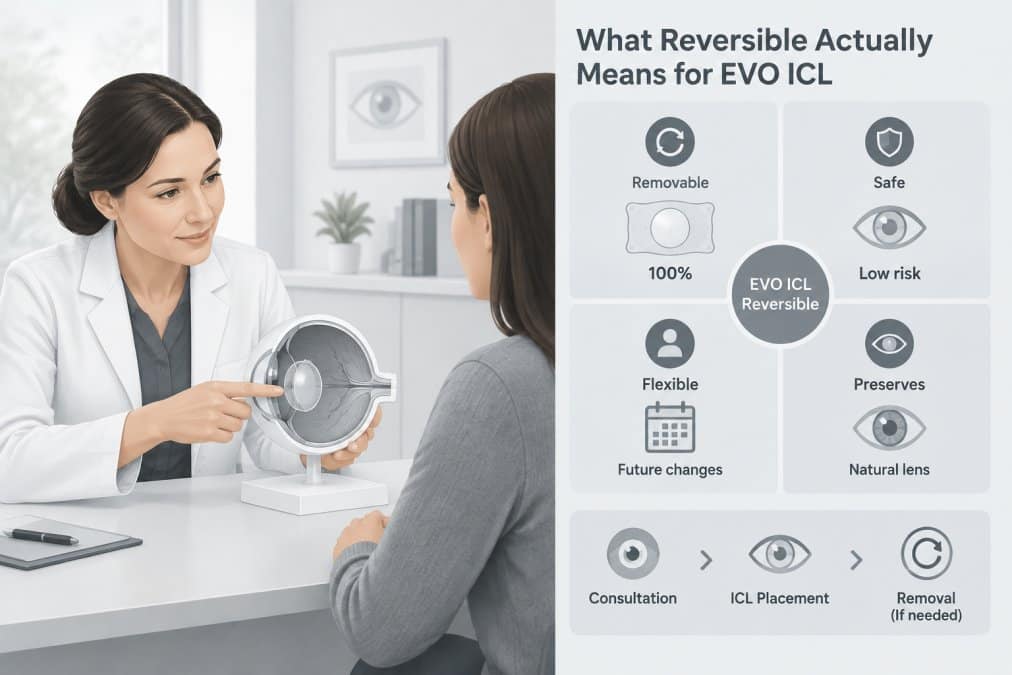
What Reversible Actually Means for EVO ICL
Is EVO ICL reversible for future vision changes? Yes, EVO ICL reversible vision correction means the implantable Collamer lens can be removed or exchanged by a surgeon if your prescription changes later. That design is the core difference between a lens-based approach and permanently reshaping the cornea.
At Schneider LASIK, we explain reversibility this way: it is an option held in reserve, not a promise that every future change can be undone with a simple removal. For candidacy, procedure details, and how to book, see EVO ICL.
How the Implantable Collamer Lens Sits in the Eye
The EVO ICL is a phakic intraocular lens, meaning it is placed inside the eye while the natural crystalline lens stays in place (the FDA). The surgeon positions it behind the iris and in front of your natural lens. No corneal tissue is removed and the cornea is not reshaped. Because the eye’s optical system keeps its original structures, the lens can later be taken out or swapped without undoing a permanent cut.
What Removal and Exchange Involve
Removal is a surgical procedure, not an office visit. The surgeon re-enters the eye and lifts the lens out; an exchange places a new lens in the same space. A retrospective analysis of EVO/EVO+ ICL found the procedure offers favorable visual outcomes and is effective for myopia with or without astigmatism (peer-reviewed EVO/EVO+ ICL analysis). That study describes outcomes, not what removal restores.
Here is what reversibility does and does not involve for the EVO ICL.
| Item | Value | Note |
|---|---|---|
| Lens type | Phakic intraocular lens | Natural crystalline lens stays in place |
| Position in eye | Behind the iris, in front of natural lens | No corneal tissue removed or reshaped |
| Removal | Surgical procedure | Surgeon re-enters eye and lifts lens out |
| Exchange | New lens placed in same space | Same session or planned second visit |
| Incision site | Typically same area as original implantation | Small incision |
| Presbyopia onset | Around the mid-40s | ICL does not stop this change |
What Lens Removal Can and Cannot Restore
Removal can restore the eye’s preoperative refractive state in the sense that the lens is no longer shaping your vision. What it cannot do is reset the eye to its condition on the day before surgery. The cornea was never cut, but the eye has aged, and any prescription change that happened while the lens was in place still reflects your eye’s current optics.
A common pattern is for patients to assume that removal returns them to their exact pre-surgery vision. In practice, the eye’s baseline has shifted. The natural lens continues to change with age, the cornea may develop regular astigmatism over time, and tear film quality can fluctuate. Removal takes the ICL out of the optical equation, but it does not reverse those underlying changes. Most practitioners find that removal brings vision back toward the original prescription, not to a pristine baseline.
How Removal and Exchange Are Performed
Removal is a surgical procedure, not an office visit. The surgeon re-enters the eye through a small incision, typically in the same area used for the original implantation, and lifts the lens out. An exchange places a new lens in the same space during the same session or a planned second visit.
A retrospective analysis of EVO/EVO+ ICL found the procedure offers favorable visual outcomes and is effective for myopia with or without astigmatism (peer-reviewed EVO/EVO+ ICL analysis). That study describes outcomes, not what removal restores.
What Removal Cannot Restore
Removal cannot undo complications that occurred while the lens was in place. If the ICL caused elevated intraocular pressure, endothelial cell loss, or a cataract during its time in the eye, removing the lens stops further exposure but does not reverse damage already done. Endothelial cells do not regenerate, and cataract progression does not reverse on its own. This is why monitoring during the implant period matters as much as the reversibility itself.
Removal also cannot guarantee freedom from future vision changes. Presbyopia, age-related macular changes, and other conditions continue on their own timeline. A patient who has an ICL removed at 50 may still need reading glasses, and a patient who has one removed at 60 may still develop a cataract that requires surgery. Reversibility is a tool for managing refractive error, not a shield against aging.
Treating removal as a simple undo button is a common misunderstanding. It is a second intraocular procedure with its own risks, recovery, and clinical considerations, and the decision belongs with your surgeon after a full evaluation.
EVO ICL vs LASIK: How the Reversibility Gap Works
The practical difference between EVO ICL and LASIK comes down to what happens to the cornea. LASIK removes and reshapes corneal tissue to change the eye’s focusing power. That reshaping is permanent. PRK and SMILE work on the cornea too, so the same logic applies.
EVO ICL leaves the cornea intact and adds a lens instead. If your vision changes years later, the lens can be removed or exchanged, and your cornea still has its original shape. For patients with thin corneas or dry eye, that preserved tissue can matter as much as the reversibility itself. If you want the longer view on permanence, read our article on whether LASIK is permanent and how results hold up over decades.
Age-Related Vision Changes and Your Prescription
Here is the part most guides skip: reversibility interacts with age. Around the mid-40s, the natural lens loses flexibility and near vision blurs, a shift called presbyopia. EVO ICL corrects your distance prescription but does not stop that change. A lens exchange can address a new prescription, yet reading glasses may still enter the picture.
That is why timing matters. A 28-year-old and a 48-year-old can both be candidates, but the meaning of “reversible” differs for each. Our team reviews vision correction options tailored to your age and lifestyle so the plan accounts for changes ahead, not just today’s prescription.
Cataract Surgery After ICL: What Your Future Options Look Like
Cataract surgery remains available after EVO ICL, and this is where the lens-based approach pays off. When the natural lens clouds with age, the surgeon removes it and places a standard intraocular lens, the same operation anyone would have. The ICL is removed as part of that planning.
Patients who want to understand lens-based correction more broadly can review refractive lens exchange, which replaces the natural lens outright. Neither path is better in the abstract; the right choice depends on your age, your prescription, and the health of your natural lens.
Long-Term Effects of EVO ICL and the Limits of Safety Data
Long-term effects of EVO ICL are generally discussed in terms of visual acuity, lens position, and eye health monitored at regular visits. What the evidence cannot do is promise a lifetime outcome. Published data covers defined follow-up periods, and every surgical eye carries some risk of complications, including elevated pressure or lens-related issues that monitoring is designed to catch.
What Long-Term Monitoring Actually Looks Like
Follow-up visits are scheduled at intervals determined by your surgeon after implantation. Endothelial cell density is a key metric because the ICL sits close to the cornea and any long-term cell loss matters for corneal health. A common pattern is for surgeons to compare endothelial cell counts over time and to consider removal or exchange if the trend raises concern.
Signs that warrant evaluation between scheduled visits include sudden changes in vision, eye pain, redness, halos or glare that worsen rather than improve, and a noticeable shift in prescription. Most of these turn out to be benign, but they are the reasons monitoring exists. The decision to monitor, exchange, or remove a lens is a clinical judgment that weighs the stability of the prescription, the health of the eye, the patient’s age and lifestyle, and the risks of a second procedure.
The Limits of Safety Data
The clinical evidence on EVO ICL comes largely from prospective and retrospective studies with follow-up periods measured in years, not decades. The long-term picture for any implanted lens is still being studied, and the evidence has boundaries that your surgeon can review with you.
That does not mean the procedure is unsafe. It means the evidence has boundaries. A patient considering EVO ICL should understand that reversibility is a feature of the lens design, not a guarantee that removal will be risk-free or that the eye will return to its original state. The strongest safety claims come from the combination of careful candidacy screening, regular monitoring, and a surgeon who is willing to recommend removal or exchange when the clinical picture calls for it.
Watch out: treating reversibility as a guarantee of safety is the most common misunderstanding we see. Removal is a second procedure with its own risks, and the decision belongs with your surgeon after a full evaluation.
Schedule a Consultation to Review Your Candidacy
Candidacy for EVO ICL depends on your prescription, corneal thickness, eye health, and age. A consultation with our team includes a full eye exam and an honest conversation about what reversibility can and cannot do for you. Schneider LASIK offers customized vision correction built around your age, prescription, and lifestyle, with a team led by Mark Schneider, M.D., named a Top Ophthalmologist seven times by the Consumers Research Council of America.
Book a vision correction consultation to review your candidacy and get answers specific to your eyes.
Frequently Asked Questions
Is the EVO ICL procedure considered permanent?
The implant is designed to stay in place indefinitely, but the procedure is not permanent in the way laser surgery is. Because EVO ICL does not remove corneal tissue, an ophthalmologist can remove or exchange the lens if your vision needs change. Think of it as a long-term implant with a removal option, not a one-way procedure.
Can an EVO ICL be removed if my vision changes with age?
Yes. The lens can be removed or replaced when a prescription change makes that the right call. That matters because age-related vision changes, including presbyopia, affect nearly everyone eventually. Removal is a surgical procedure with its own risks, so it is not automatic. Your ophthalmologist will weigh the benefit against a second intraocular procedure. The EVO ICL reversible design preserves that choice, but the decision belongs in a consultation, not a blanket promise.
What happens to the EVO ICL if I need cataract surgery later?
Cataract surgery after ICL is possible. The implantable collamer lens is removed during the cataract procedure, and a standard intraocular lens is placed in its position. Because the natural crystalline lens was never removed during ICL implantation, the cataract develops as it would in any eye. Your surgeon plans the cataract operation knowing the ICL is there, which is why telling any future eye doctor about your implant matters.
How does EVO ICL compare to LASIK in terms of reversibility?
LASIK reshapes the cornea permanently by removing corneal tissue, so the change cannot be undone. EVO ICL adds a lens without removing corneal tissue, which is why it can be removed or exchanged. Reversibility is an option, not a guarantee that removal restores your exact preoperative state.
Your vision will change over the decades, and the correction you choose now should leave room for that. Schneider LASIK provides personalized EVO ICL, LASIK, PRK, and refractive lens exchange evaluations using state-of-the-art exam technology and financing options to make treatment manageable. Get started with Schneider LASIK and choose a plan that keeps your future options open.