


Last Updated: November 4, 2026
Quick Summary
Long-term data on refractive lens exchange is encouraging: a five-year study cited by Optegra found 99.5% of patients reached driving-standard vision or better, and functional outcomes studies report good unaided vision at all distances with high patient satisfaction. Results typically stay stable for years, though some patients still need readers for very fine print.
- Most patients notice clearer vision within a few days and return to normal activities within a week.
- Posterior capsular opacification can develop months to a few years after surgery and is treated with YAG laser capsulotomy.
- The IOL itself does not wear out, cloud over, or need replacement on a schedule.
- A sudden change in vision years after surgery deserves a same-week call to your eye doctor.
- Annual eye exams after surgery check eye pressure, retinal health, and refractive stability.
Table of Contents
- What Five-Year Data Shows About Refractive Lens Exchange Outcomes
- Refractive Lens Exchange Pros and Cons for Long-Term Vision
- Clear Lens Extraction Side Effects That Can Appear Years Later
- Refractive Lens Exchange Recovery Time and the First Year of Healing
- Clear Lens Extraction vs Cataract Surgery: How the Long-Term Paths Differ
- Long-Term IOL Maintenance and Secondary Procedures
- Schedule a Consultation to Review Your Long-Term Vision Plan
- Frequently Asked Questions
What Five-Year Data Shows About Refractive Lens Exchange Outcomes
Refractive lens exchange is a procedure that replaces your eye’s natural lens with an artificial intraocular lens (IOL) to correct focusing problems. Long-term data on refractive lens exchange outcomes is encouraging: most patients keep good vision for years after surgery.
The numbers back this up. Research published in a peer-reviewed functional outcomes study found that bilateral refractive lens exchange with trifocal IOLs produced good unaided vision at all distances, with high patient satisfaction. A five-year study cited by Optegra’s long-term outcome review reported that 99.5% of patients reached driving-standard vision or better.
Visual Acuity Results at Distance, Intermediate, and Near
Vision after refractive lens exchange typically holds steady across all three ranges. Functional outcome studies of refractive lens exchange have reported improved uncorrected vision at far, intermediate, and near distances in many patients.
What does that mean in daily life? Most patients can drive, use a computer, and read a menu without glasses. Some still need readers for very fine print, especially with certain lens types.
Here are the key long-term outcome figures reported in the article.
| Measure | Result | Source |
|---|---|---|
| Patients reaching driving-standard vision or better | 99.5% | Five-year study cited by Optegra |
| Unaided vision at all distances with trifocal IOLs | Good, with high patient satisfaction | Peer-reviewed functional outcomes study |
| Vision at far, intermediate, and near distances | Improved uncorrected vision in many patients | Functional outcome studies |
| Need for reading glasses after surgery | Some still need readers for very fine print | Article summary |
Refractive Lens Exchange Pros and Cons for Long-Term Vision
Weighing refractive lens exchange pros and cons comes down to matching the procedure to your eyes and lifestyle. Here is the honest breakdown.
Pros:
- Many patients report high satisfaction with their post-surgery vision
- One procedure corrects nearsightedness, farsightedness, astigmatism, and presbyopia at once
- No future cataract surgery needed, since the natural lens is already replaced
- Stable results that last for years
Cons:
- It is surgery, with rare but real risks like retinal detachment or infection
- Coverage varies, and insurance often does not cover it when done for vision correction alone; check with your provider
- Some patients notice glare or halos around lights at night
- Reading glasses may still be needed for close work
Want to see whether your eyes fit the profile? Take our RLE self test for a quick check.
Clear Lens Extraction Side Effects That Can Appear Years Later
Most side effects of refractive lens exchange show up in the first weeks, but the ones that matter for the keyword are the ones that can surface years later. Knowing the timeline helps you separate a normal healing phase from something that needs a call to your surgeon.
The most common long-term issue is posterior capsular opacification (PCO), a clouding of the thin capsule that holds the IOL. It is not a return of your original prescription and it is not the lens itself failing, it is a film of cells that grows across the back of the capsule.
Other long-term concerns worth knowing:
- Retinal detachment. Rare, but the risk is higher in highly nearsighted eyes and in the first few years after surgery. It is a medical emergency, sudden flashes, a shower of new floaters, or a curtain over part of your vision means call your eye doctor the same day.
- IOL dislocation or subluxation. Uncommon, but it can happen years later, especially in eyes with weak zonules (the fibers that hold the lens). Symptoms include a sudden shift in vision or double vision in one eye.
- Cystoid macular edema. A swelling of the retina that can appear weeks to months after surgery and is more common in patients with diabetes or prior eye inflammation. It is treatable with drops or injections but needs to be caught early.
- Persistent dry eye. Many patients notice dry eye in the first year; a smaller group finds it persists or returns, particularly in dry climates or with heavy screen use.
- Refractive shift. The eye can change over decades, not because the IOL wears out, but because the cornea and the eye’s overall optics can shift. A small residual prescription years later is not a failure of the surgery; it is a normal aging change that can often be addressed with glasses, contacts, or a laser enhancement.
Watch out: a sudden change in vision years after surgery, not a gradual one, is the pattern that deserves a same-week call rather than a wait-and-see approach.
The American Refractive Surgery Council notes these risks are rare but worth discussing with your surgeon before surgery, not after. The practical takeaway is that long-term side effects are manageable when they are monitored, which is why annual eye exams matter more after RLE than before it.
Curious how vision changes over a decade after eye surgery? Read our guide on what happens 10 years after LASIK for more context.
Refractive Lens Exchange Recovery Time and the First Year of Healing
Refractive lens exchange recovery time is shorter than many patients expect. Most people notice clearer vision within a few days and return to normal activities within a week.
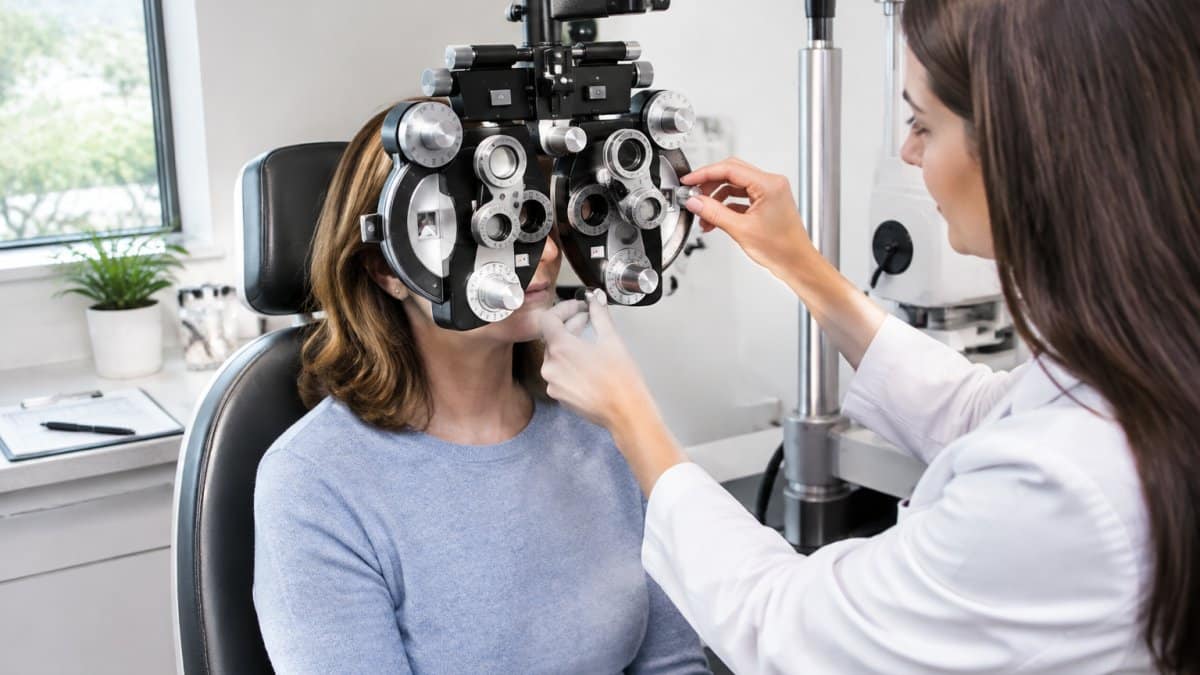
Here is how the first year typically unfolds:
- Days 1-3: Blurriness and mild discomfort are normal. Rest and use prescribed drops.
- Week 1: Vision sharpens. Most patients return to work and light activity.
- Months 1-3: Vision stabilizes. Night glare and halos usually fade.
- Months 6-12: Final prescription settles. Your surgeon confirms long-term stability.
Attend every follow-up visit. These checks catch issues early, when they are easiest to treat.
Clear Lens Extraction vs Cataract Surgery: How the Long-Term Paths Differ
Clear lens extraction vs cataract surgery is a common question, and the answer surprises people: the surgery itself is nearly identical. Both replace your natural lens with an IOL.
The difference is timing and reason. Cataract surgery removes a lens that has already clouded. Clear lens exchange removes a clear lens to fix a refractive error, often before a cataract forms. In recent evidence reviews, refractive lens exchange accounted for 80% of reported refractive surgery cases (Nature Eye analysis(https://www.nature.com/eye)).
Long term, the paths look similar: stable vision, routine follow-ups, and possible laser treatment for capsule clouding. One practical difference is cost. Since RLE is elective, insurance usually will not pay. See our breakdown of refractive lens exchange cost for presbyopia before you plan.
Long-Term IOL Maintenance and Secondary Procedures
An IOL does not wear out, cloud over, or need to be replaced on a schedule. That is the single most reassuring fact about long-term IOL maintenance, and it is also where most articles stop.
The IOL itself. Modern IOLs are made of acrylic or silicone and are designed to last a lifetime. They do not degrade from sunlight, exercise, or screen use. What can change is the capsule around them (PCO, covered above) and the optics of the eye itself.
Secondary procedures you may encounter:
- YAG laser capsulotomy for PCO. This is by far the most common secondary procedure, typically performed in the office in under 15 minutes. Most patients notice clearer vision within a few days.
- Laser enhancement (LASIK or PRK touch-up) for a small residual prescription that appears years later. This is more common after monofocal IOLs than after premium lenses, and it is usually a minor procedure rather than a second lens exchange.
- IOL exchange. Rare, most practitioners reserve it for a dislocated lens, a lens that is badly off-target, or a patient who cannot adapt to a premium lens. It is a more involved surgery than the original procedure and is not a routine option.
- Glaucoma and retinal monitoring. Annual exams after RLE check eye pressure and retinal health, because the same age-related conditions that affect everyone else still apply, and because some long-term risks (retinal detachment, macular edema) are easier to treat when caught early.
Lifestyle-specific long-term outcomes. This is where the keyword gets practical.
Cost over a 20-year horizon. RLE is typically not covered by insurance when done for vision correction alone, so the upfront cost is real. A clinical case series on the Light Adjustable Lens also showed a substantial drop in refractive surprises, which matters for the small group of patients who want the ability to fine-tune the result after surgery.
Watch out: the biggest long-term mistake patients make is skipping annual exams once their vision feels stable, the conditions that matter most at year 10 are the ones that are silent at year two.
Your annual eye exam remains essential. It checks eye pressure, retinal health, and overall refractive stability. Lifestyle matters too: patients who play tennis, swim, or work long hours on screens often report that stable, glasses-free vision is the biggest payoff.
Schedule a Consultation to Review Your Long-Term Vision Plan
Long-term vision is a plan, not a single appointment. The data points one way: most patients do well for years, but the best outcomes come from careful candidate selection and consistent follow-up.
At Schneider LASIK, our team offers customized vision correction based on your age, prescription, and lifestyle. We use state-of-the-art exam and treatment technology. Financing options are available.
Get started with Schneider LASIK and build a long-term vision plan that fits your life. Schedule a vision correction consultation with our team today.
Frequently Asked Questions
How long do the results of refractive lens exchange last?
The implanted intraocular lens does not wear out, so the refractive correction itself is designed to last a lifetime. Long-term studies generally report stable refractive results for many patients over several years. What can change is the tissue around the lens. Posterior capsular opacification, a clouding of the lens capsule, can develop months or years later and is treated with a brief laser procedure. Regular long-term follow-up catches these changes early.
Can vision change years after refractive lens exchange?
Yes, though usually for reasons outside the lens itself. Posterior capsular opacification is the most common cause of gradual blurring after surgery and affects a meaningful share of patients at some point. Retinal changes, glaucoma, and dry eye syndrome can also affect visual acuity independently of the implant. Research notes that younger patients may see different long-term stability than older patients because their eyes continue to change naturally. This is why ongoing follow-up with your ophthalmologist matters more than the surgery date itself.
What are the long-term side effects of refractive lens exchange?
Most side effects show up early: glare, halo effect, and contrast sensitivity changes in low light, which often settle as the brain adapts. Long-term concerns include posterior capsular opacification, dry eye syndrome, and rare but serious events such as retinal detachment, infection, raised eye pressure, or IOL dislocation, per the American Refractive Surgery Council. A preoperative retinal evaluation is an important part of planning for RLE. Discuss your personal risk profile at a consultation.
Can you still need glasses after refractive lens exchange?
Some patients do, particularly for fine near tasks or night driving. Trifocal and multifocal lenses are designed to reduce dependence across distance, intermediate, and near vision, and Published research on bilateral RLE with trifocal IOLs has reported good unaided vision at multiple distances. Still, outcomes vary with lens choice, corneal health, and lifestyle. Monovision setups trade depth of field for near vision. Set expectations with your surgeon around what your specific prescription and daily demands make realistic.
Your eyes deserve a clear plan for the decades ahead. Talk to a qualified eye surgeon about whether refractive lens exchange fits your eyes, your health, and your daily needs.