


Last Updated: October 27, 2026
Quick Summary
Managing presbyopia after LASIK is possible because your surgery did not fail; the eye’s lens stiffens with age and no laser reshapes that lens. Options for presbyopia after LASIK include reading glasses, multifocal contacts, monovision LASIK, corneal inlays, and refractive lens exchange, but candidacy depends on your cornea, lens, and prescription history.
- LASIK cannot correct or prevent the age-related loss of near focusing power, per the FTC.
- Presbyopia is a stiffening lens; LASIK regression is a partial return of your refractive error.
- A thin post-LASIK stromal bed may rule out an enhancement or inlay.
- Post-LASIK dry eye usually needs treatment before any enhancement is considered.
- Write down your top three visual tasks and two biggest deal-breakers for your consultation.
Table of Contents
- Why Near Vision Changes After LASIK
- Presbyopia Treatment Options After LASIK
- Contact Lenses for Presbyopia After LASIK
- Monovision LASIK for Presbyopia: How It Works and Who It Fits
- How to Compare Options by Your Daily Visual Priorities
- What to Expect at a Post-LASIK Presbyopia Consultation
- Schedule Your Post-LASIK Vision Assessment
- Frequently Asked Questions
Why Near Vision Changes After LASIK
Managing presbyopia after previous LASIK starts with one fact: your surgery did not fail. The eye’s lens stiffens with age, and no laser reshapes that lens. An estimated 128 to 139 million people in the United States are presbyopic, according to CRSToday’s 2026 review of surgical presbyopia management. Some of them had LASIK years ago.
The Difference Between LASIK Regression and Presbyopia
Presbyopia is the age-related loss of near focus caused by a stiffening crystalline lens. LASIK regression is a partial return of your original refractive error, such as myopia, after surgery.
The Federal Trade Commission’s guide to LASIK basics explains that LASIK cannot correct or prevent this age-related loss of focusing power for near objects. They are separate problems with separate fixes.
How to Tell Which One You Are Experiencing
- Near blur only, distance still sharp: most likely presbyopia
- Distance blur returning too: possible regression or a new refractive error
- Both, plus glare or halos: worth a full exam
- Only one eye affected: needs evaluation, not guesswork
Do not self-diagnose.
Presbyopia Treatment Options After LASIK
Several presbyopia treatment options exist for people with prior laser vision correction, and the right one depends on your cornea, your lens, and your daily visual demands.
Comparison of Treatment Approaches
| Option | What It Does | Best For | Main Trade-Off |
|---|---|---|---|
| Reading glasses | Magnifies near tasks | Simplest, lowest risk | You still depend on glasses |
| Multifocal contacts | Multiple focal zones | Active, glasses-free days | Adaptation period, dry eye |
| Monovision LASIK | One eye near, one far | Mild to moderate presbyopia | Reduced depth perception |
| Corneal inlay | Small implant in one cornea | Select prior-LASIK patients | Removal possible, screening strict |
| Refractive lens exchange | Replaces the lens | High prescriptions, early cataract | Intraocular surgery risk |
A 2007 study by R. C. Ghanem and coauthors in PubMed found LASIK for myopia and hyperopia had reasonable safety, efficacy, and predictability profiles in presbyopic patients aged 40 to 69. That supports laser options, not a guarantee for every eye.
Why a Prior-LASIK Cornea Changes the Math
Every option above is still on the table in principle, but candidacy is filtered through what your first surgery left behind. Clinicians typically weigh:
- Residual corneal thickness. A second laser treatment removes more tissue. If your post-LASIK stromal bed is thin, an enhancement or inlay may be off the table regardless of your prescription.
- Corneal shape and topography. Irregular astigmatism or a decentered ablation zone can make a multifocal ablation unpredictable and can complicate inlay centration.
- Flap or cap position. A prior flap limits where an inlay can sit and how a surgeon plans the second treatment zone.
- Ocular surface health. Post-LASIK dry eye is common and can distort topography and blur vision; it usually needs to be treated before any enhancement is considered.
- Prescription stability. A refraction that has drifted over the past year points to regression or lens changes, not just presbyopia, and changes the recommendation.
This is why a post-LASIK presbyopia plan starts with records and measurements, not a procedure menu.
The Two Surgical Alternatives Worth a Closer Look
One surgical option to discuss is refractive lens exchange.
- Refractive lens exchange. The eye’s natural lens is replaced with an intraocular lens.
Watch out: CRSToday’s 2021 discussion of post-LASIK presbyopia cautions that early-presbyopic patients may lose remaining accommodative ability after intraocular surgery, which carries its own risk. Informed consent matters more than speed here.
For a prior-LASIK eye, the question is not “which presbyopia treatment is best” but “which options my cornea, lens, tear film, and prescription history will safely support.” Ask for that candidacy reasoning in writing.
Contact Lenses for Presbyopia After LASIK
Your cornea was reshaped by surgery, so fit matters. A 2023 Contact Lens Update editorial reviewed pharmacologic and contact-lens management options following LASIK. Expect a proper topography-based fit, not an online order.
Monovision LASIK for Presbyopia: How It Works and Who It Fits
Depth perception and night vision can change. Test before you commit.
How to Compare Options by Your Daily Visual Priorities
Start with your day, not the procedure. Most treatment lists tell you what each option does; almost none tell you how to choose between them when your priorities conflict. That is the gap this section fills. Your visual priorities narrow the field fast, and for a prior-LASIK eye they also tell your clinician which trade-offs you can actually live with.
A Practical Decision Matrix
| Your priority | What it demands | Options that tend to fit | Options that tend to strain |
|---|---|---|---|
| Reading and fine print | Strong near acuity at 14-18 inches | Reading glasses, multifocal contacts, corneal inlay, multifocal IOL | Distance-only monovision |
| Computer work | Solid intermediate vision at arm’s length | Multifocal contacts, extended-depth-of-focus IOL, modified monovision | Strong monovision |
| Night driving | Contrast sensitivity and glare control | Reading glasses over distance correction, monofocal distance IOL with readers | Multifocal IOLs, corneal inlays, aggressive monovision |
| Depth perception for work or sport | Binocular stereoacuity | Reading glasses, multifocal contacts (with careful fitting) | Monovision of any kind |
| Low tolerance for risk or reversibility | Ability to undo or opt out | Reading glasses, daily disposable contacts, removable inlay | Refractive lens exchange, laser enhancement |
| Glasses-free most of the day | Independence from frames | Multifocal contacts, monovision, multifocal IOL | Reading glasses as primary plan |
How to Read Your Own Matrix
- If near and intermediate tasks dominate and night driving is low-stakes, a multifocal contact trial or a multifocal IOL conversation is reasonable.
- If night driving, depth perception, or fine stereo work is a 5, monovision and multifocal optics are the options to test most cautiously, ideally with a contact lens trial first.
- If reversibility is a 5, non-surgical options and removable inlays move to the top, and lens replacement moves down.
- If you already dislike glasses and hated monovision in a contact trial, that is useful data, not a failure, it steers you toward multifocal optics or a lens-based discussion.
Bring the Matrix to Your Consultation
Write down your top three visual tasks and your two biggest deal-breakers. Bring that list to your consultation.
What to Expect at a Post-LASIK Presbyopia Consultation
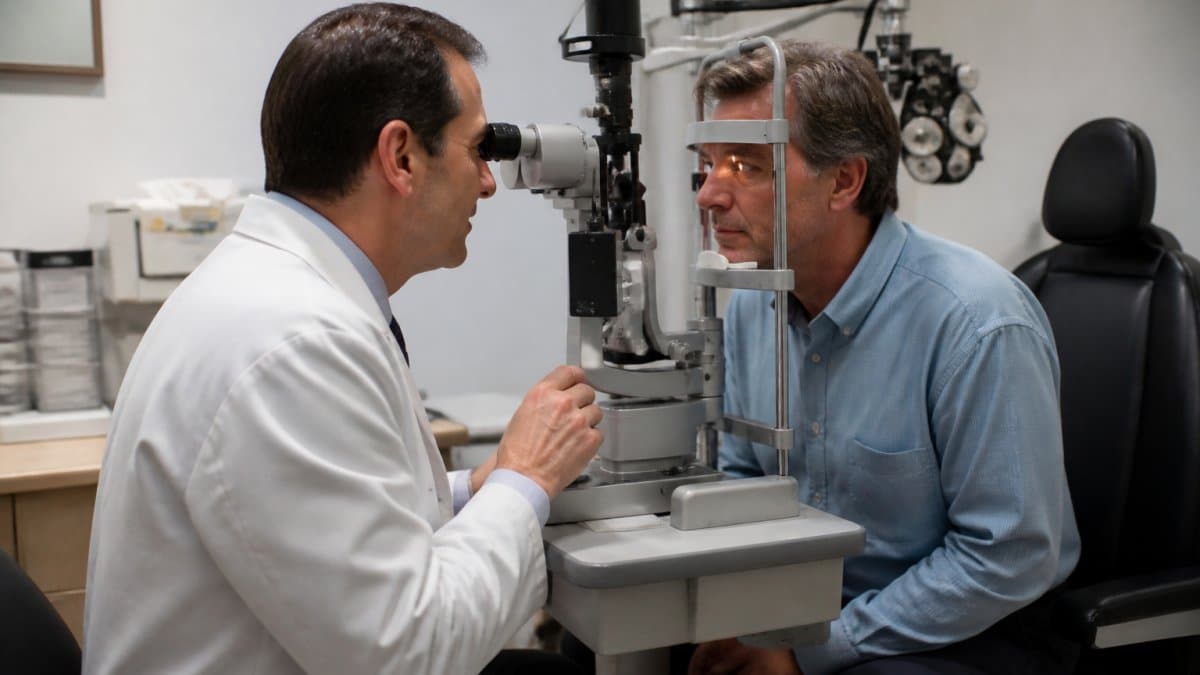
Questions worth asking: What is my residual corneal thickness? How stable has my prescription been? What happens if I am unhappy with the result? Is the procedure reversible? It also helps to review LASIK post-operative care so you know what follow-up after surgery involves.
Schedule Your Post-LASIK Vision Assessment
The right answer depends on your eyes, not a search result. Get measured before you decide.
Schneider LASIK offers customized vision correction based on age, prescription, and lifestyle, with state-of-the-art exam and treatment technology and a team led by Mark Schneider, M.D., named a Top Ophthalmologist seven times by the Consumers Research Council of America.
Request an in-office consultation and get a clear plan for your near vision.
Frequently Asked Questions
Can you develop presbyopia after LASIK?
Yes. LASIK corrects the refractive error you had at the time of surgery, but it does not stop the age-related hardening of the crystalline lens that causes presbyopia. The FTC notes that LASIK cannot prevent the natural loss of near focusing power.
Can you wear contact lenses for presbyopia after LASIK?
A 2023 Contact Lens Update editorial reviewed contact-lens management options following LASIK.
Is monovision an option for presbyopia after LASIK?
Monovision is an option, but it involves trade-offs. The approach sets one eye for distance and the other for near, relying on the brain to suppress the blur from the non-dominant eye. Some patients adapt well; others notice reduced depth perception, contrast sensitivity, or glare at night. A 2007 study in PubMed found LASIK for myopia and hyperopia had reasonable safety and efficacy profiles in presbyopic patients aged 40 to 69, but candidacy still depends on your corneal thickness, prescription, and lifestyle demands.
How do you manage presbyopia after previous LASIK?
Options include refractive lens exchange. Schneider LASIK offers customized vision correction based on age, prescription, and lifestyle.
Your near vision changed because your lens aged, not because your surgery failed. Find out which option fits your eyes and your daily life. Get started with Schneider LASIK and schedule an evaluation with our team.