



Table of Contents
- 1. Freedom From Glasses and Contacts During Spontaneous Activity
- 2. LASIK vs Contacts for Sports: Which Keeps Up With You?
- 3. Is LASIK Permanent? Long-Term Results and Vision Stability
- 4. LASIK Recovery Timeline for Athletes: Return to Play
- 5. Improved Sports Performance, Depth Perception, and Peripheral Vision
- 6. The Psychological Benefits of Visual Independence
- 7. Long-Term Cost Savings: LASIK vs Eyewear Maintenance
- Frequently Asked Questions
Last Updated: September 13, 2026
1. Freedom From Glasses and Contacts During Spontaneous Activity
For anyone who has ever skipped a swim because their contacts were bothering them or turned down a pickup game because glasses would slide off, the appeal of lasik for active lifestyles comes down to a single word: spontaneity. Laser vision correction is a refractive surgery that reshapes the cornea to reduce or eliminate dependence on corrective eyewear, and for active people, that freedom changes how you move through an ordinary day (the FDA).
Consider what eyewear dependence actually costs you. You pack solution and a case for a weekend trip. You avoid the pool because you cannot see the lane markers without contacts. You keep a spare pair in the car in case something breaks. Each of those small calculations disappears after a corrective procedure.
The benefits of LASIK for people with an active lifestyle start with this: no more planning your day around your eyewear. You wake up, see clearly, and go. For patients in Southern California who hike, surf, or train outdoors, that shift is often the most immediate and noticeable change.
The biggest early win from LASIK is not sharper vision on a chart. It is the removal of dozens of small daily decisions you no longer have to make.
2. LASIK vs Contacts for Sports: Which Keeps Up With You?
For most athletes, LASIK outperforms contacts for sports because it removes the lens entirely, along with the dryness, displacement, and hygiene routines that come with it. Contacts can shift during a hard sprint, dry out in wind or air conditioning, and require handling with clean hands mid-activity. LASIK eliminates those variables.
That said, the comparison is not one-sided. Contacts remain a reasonable option for someone who is not a candidate for surgery or who wants a reversible choice. Here is how the two stack up for active use:
| Factor | LASIK | Contacts for Sports |
|---|---|---|
| Mid-activity issues | None from eyewear | Can dry, shift, or fall out |
| Maintenance | None after recovery | Daily cleaning and storage |
| Water sports | Generally workable after healing | Not recommended in pools or open water |
| Reversibility | Permanent change | Fully reversible |
| Best for | Stable prescriptions, active routines | Anyone not ready for surgery |
A common mistake is assuming contacts are the “safe” default for sports. In practice, contact lens intolerance and dry eye syndrome push many active adults to look for a longer-term answer.
3. Is LASIK Permanent? Long-Term Results and Vision Stability
LASIK is considered a permanent procedure because it reshapes the cornea, and that change does not reverse on its own. The vision correction itself lasts, though your eyes can still change with age, which is why long-term results depend partly on your prescription being stable before surgery.
For an athlete, the more useful question is not “is it permanent” but “will it hold up across the seasons I actually train and compete in.” That answer depends on three variables most guides skip: your age at treatment, your pre-surgery prescription stability, and the natural aging of the lens inside your eye.
Age and the reading-glasses clock. LASIK corrects the vision you have now. It does not stop presbyopia, the age-related stiffening of the lens that typically begins to show up in the early-to-mid forties. A runner who has LASIK at 32 may go a decade or more with no eyewear at all, then need low-power reading glasses for close work, while still seeing clearly at distance for cycling, skiing, or tennis. A patient treated at 48 may notice near-vision changes sooner. Neither outcome means the procedure “wore off”; it means the cornea was corrected and the lens kept aging on its own schedule.
Prescription stability is the gate. Most surgeons want to see a prescription that has been stable for at least a year, often two, before recommending treatment (aoa.org). A still-shifting prescription is the single biggest predictor of a touch-up later. For a college athlete or a weekend warrior in their twenties whose vision is still drifting, waiting a season is usually the smarter call than treating early and re-treating soon.
Enhancements, not do-overs. If a small residual error remains or a prescription drifts years later, an enhancement procedure can often refine the result. This is not a failure of the original surgery, it is a planned possibility that most reputable practices discuss up front. Ask what your provider’s enhancement policy covers and for how long.
What this means for training continuity. Because the correction is stable, athletes generally do not lose ground mid-season to a changing prescription. The glasses you trained in last year are not the glasses you need this year, because there are none. That consistency is the real long-term benefit: your visual input stays constant while your fitness, technique, and equipment evolve around it.
Permanence is about the cornea, not the calendar. LASIK locks in your current correction; it does not freeze your eyes in time. Plan for the correction you need now, and expect the natural lens changes everyone eventually faces.
4. LASIK Recovery Timeline for Athletes: Return to Play
Most athletes can return to light activity within a few days of LASIK and to full-contact or high-impact sports after a few weeks, once the corneal flap has healed and your surgeon clears you. The exact timeline depends on the sport and how your eyes respond.
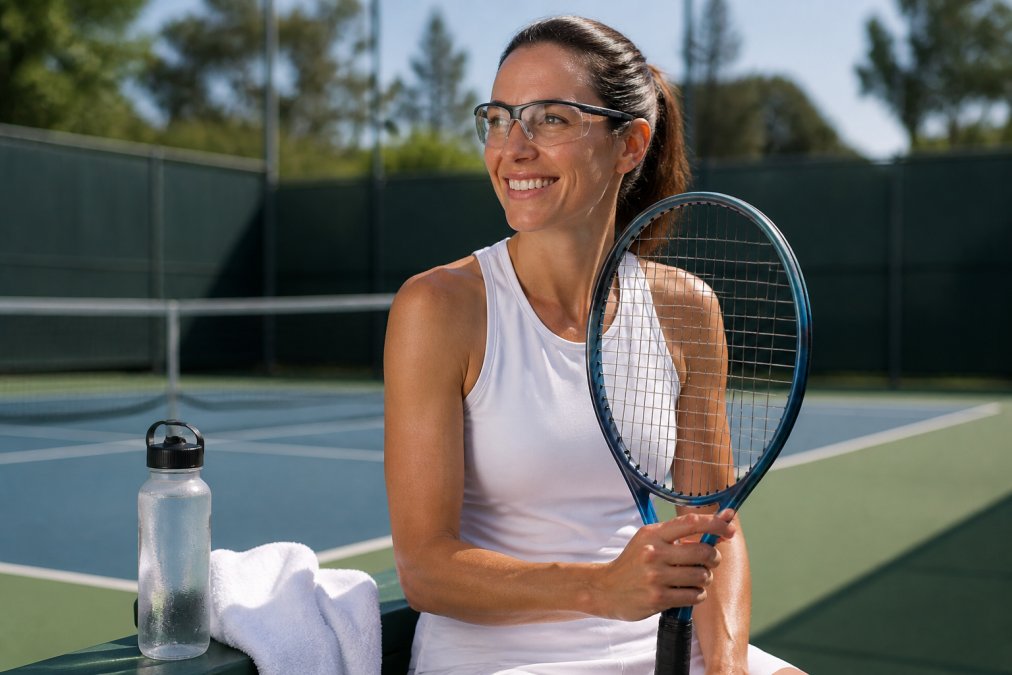
Here is a practical return-to-play framework:
- Days 1-2: Rest. No screens for long stretches. Many patients report the procedure itself is pain-free, with mild irritation afterward.
- Days 3-7: Light cardio and walking. Avoid sweat in the eyes and skip the pool entirely.
- Weeks 2-3: Non-contact training. Jogging, cycling on a stationary bike, and light weights are usually fine.
- Weeks 3-4: Cleared for most high-impact sports, including running and racquet sports, once your surgeon confirms healing.
- Weeks 4+: Swimming and water sports, typically once the flap is fully secure.
Getting back on the court too early is the single most common recovery mistake. Sweat, dust, or a stray finger near a healing corneal flap can set your recovery back and risk complications. Wait for your surgeon’s clearance, not your own calendar.
5. Improved Sports Performance, Depth Perception, and Peripheral Vision
Clear, stable vision improves athletic performance because it sharpens depth perception and peripheral vision, two skills that decide how quickly you read a ball, a trail, or a competitor. When your eyes are not fighting dry contacts or fogging lenses, your brain spends less effort compensating and more on the task in front of you.
But “better vision helps sports” is where most articles stop. The useful version is sport-specific, because each activity loads a different visual skill. Here is how the demands break down, and where LASIK changes the equation.
Tennis, baseball, and softball, depth perception and focus speed. These sports require rapid accommodation: your eyes shift focus from a ball 60 feet away to the net, the batter’s box, or your own hands in a fraction of a second. A stable, corrected cornea removes the micro-blur that contacts can introduce when they dry mid-rally, and it eliminates the frame edge that cuts into your upper visual field when you look up for a lob.
Cycling and trail running, peripheral awareness at speed. At 20 mph on a descent, your safety depends on catching motion at the edges of your vision: a car door, a root, a rider drifting into your line. Glasses frames and thick lenses narrow that peripheral window. Contacts can shift or dry in wind. A corrected cornea keeps the full field clear and consistent from the first mile to the last.
Swimming and water sports, no lens in the water. Contacts are not recommended in pools or open water because of infection risk, and glasses obviously do not work (the CDC). LASIK is the only option that lets you see the lane markers, the buoy line, or the wave set without a lens on your face. Most surgeons clear patients for swimming once the corneal flap is fully secure, typically around the four-week mark.
Skiing and snowboarding, fog, glare, and cold. Goggles over glasses fog; contacts dry out in cold, dry mountain air. A corrected cornea means you can wear plain goggles for protection and glare control without a prescription insert, and you stop losing peripheral vision to fogged lenses on a whiteout run.
Golf, alignment and green reading. Putting depends on reading subtle slope and distance cues, which rely on consistent depth perception. A stable correction keeps that input the same from the practice green to the back nine, rather than shifting as contacts dry out over a four-hour round.
Martial arts and contact sports, nothing to grab or knock loose. No frames to break, no lenses to dislodge. Once cleared for contact, you train without worrying that a stray hand will send a contact behind your eyelid or snap a frame.
Hiking and climbing, handhold clarity and depth judgment. Judging a foothold or a rock edge at arm’s length while also scanning a route 100 feet up demands both near and distance clarity. Corrected vision keeps both ends of that range usable without swapping glasses.
This is where the benefits of LASIK go beyond convenience. Visual acuity that stays consistent from the first minute of a workout to the last changes how confidently you move, and in most sports, confidence and reaction time are the same thing.
When you consult a surgeon, name your specific sports. A treatment plan tuned to a swimmer’s needs is not identical to one tuned to a skier’s, and a provider who knows your activities can set realistic expectations for each.
6. The Psychological Benefits of Visual Independence
The psychological payoff of visual independence is real and often underestimated: patients describe feeling more confident, less self-conscious, and more willing to say yes to activities they used to avoid. That mental shift is one of the benefits competitors rarely mention, yet it shows up again and again in how people describe life after surgery.
Think about how much of your day is quietly shaped by eyewear. You avoid the back row because you cannot read the board. You skip the early morning swim because putting in contacts feels like a chore. You hesitate before a photo because you do not want glasses in it. Each of those moments carries a small cost.
Removing that cost changes your relationship with your own body. It is a lifestyle enhancement, not just a vision correction, and it is why many patients describe the decision as one they wish they had made sooner.
7. Long-Term Cost Savings: LASIK vs Eyewear Maintenance
Over time, LASIK can cost less than a lifetime of glasses and contacts, though the upfront price is higher than any single pair of frames. The savings come from eliminating recurring maintenance costs: replacement lenses, contact solution, new prescriptions, and the repairs that add up year after year.
The math depends on your habits. Someone who replaces contacts monthly and buys new glasses every couple of years spends steadily for decades. A one-time corrective procedure replaces that ongoing expense. For a fair comparison, look at total cost over five to ten years rather than the sticker price of either option.
Pricing for any vision correction procedure depends on your specific treatment plan, so it is worth reviewing current options and financing directly. Schneider LASIK offers affordable financing options to spread the cost.
When comparing costs, ask for the total ten-year figure, not the single-visit price. Include contacts, solution, frames, lens replacements, and prescription updates. The gap between the two options usually becomes clear fast.
Eyewear dependence quietly limits how you train, travel, and compete, and the fix is more within reach than many active adults assume. At Schneider LASIK, blade-free LASIK technology, customized treatment plans built around your age, prescription, and lifestyle, and a highly experienced medical team make the decision easier to trust. If you are ready to stop planning your life around glasses and contacts, schedule my consult with Schneider LASIK and take the first step toward lasting visual freedom.
Frequently Asked Questions
Is LASIK worth it for people with active lifestyles?
For many active adults, LASIK can reduce eyewear dependence and improve visual clarity during sports and outdoor recreation. It may eliminate fogging, dry eye from contacts, and the hassle of lost lenses. However, candidacy depends on your prescription, corneal thickness, and eye health. A consultation with an eye surgeon can determine if laser vision correction fits your lifestyle and goals.
How does LASIK improve athletic performance?
LASIK can sharpen visual acuity and depth perception, which are critical for sports like tennis, golf, and cycling. Without glasses or contacts, you may react faster to moving objects and judge distances more accurately. Many athletes report better peripheral vision and less distraction. Still, individual results vary, and your surgeon can discuss realistic expectations based on your sport and eye condition.
Can I play contact sports after LASIK surgery?
Most patients can return to contact sports after a few weeks, once the corneal flap has healed and your surgeon clears you. High-impact sports like football or basketball may require protective eyewear initially. The LASIK recovery timeline for athletes typically involves avoiding swimming pools and dusty environments for a short period. Always follow your surgeon’s specific guidance for a safe return to play.
Is LASIK permanent, and will I need reading glasses later?
LASIK permanently reshapes the cornea to correct nearsightedness, farsightedness, and astigmatism. However, age-related changes like presbyopia can still require reading glasses after age 40. Some patients may experience mild regression over time, but enhancements are often possible. Your long-term vision stability depends on factors like age, prescription, and eye health, so discuss expectations with your surgeon.