



Table of Contents
- What Is LASIK Enhancement Surgery and When Is It Needed?
- Why Vision Changes After Laser Eye Surgery
- LASIK Candidacy Requirements for a Second Procedure
- Comparing the LASIK Recovery Timeline: First vs. Second Procedure
- Risks, Complications, and Long-Term Outcomes of Repeat Laser Eye Surgery
- Financial and Insurance Implications of a Second LASIK Procedure
- Frequently Asked Questions
Last Updated: September 20, 2026
What Is LASIK Enhancement Surgery and When Is It Needed?
A LASIK enhancement is a second laser procedure that fine-tunes your vision after the first surgery. It is not a repeat of the original treatment. It is a refinement.
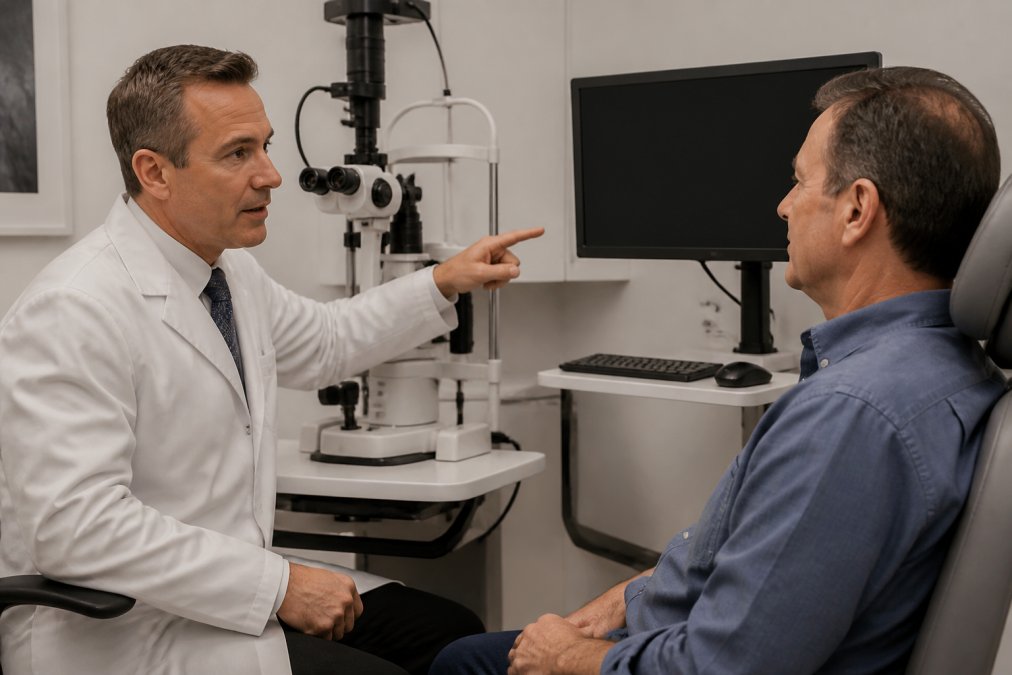
Most people who get laser eye surgery enjoy clear vision for years.
Why Vision Changes After Laser Eye Surgery
Vision regression after LASIK happens because the eye is a living organ, not a fixed lens. The cornea can shift shape slowly over time. The lens inside the eye also changes with age.
A few common causes:
- Natural aging. Presbyopia sets in around age 40, making close-up vision harder (What Is Presbyopia?).
- Corneal healing. The cornea may thicken or thin slightly as it heals.
- Hormonal shifts. Pregnancy and other changes can affect vision stability.
- Under- or over-correction. The first procedure may land slightly off target.
LASIK Candidacy Requirements for a Second Procedure
Not everyone qualifies for a second procedure. Your eye surgeon will check several things before recommending one.
LASIK candidacy requirements for an enhancement include:
- Stable vision for at least 6 to 12 months
- Enough remaining corneal thickness
- A healthy cornea with no signs of ectasia
- A prescription that the laser can still correct
- No active eye disease, such as severe dry eye syndrome
The Role of Corneal Thickness and Diagnostic Tests
Corneal thickness is the single biggest factor in whether a second procedure is possible. Every laser treatment removes a small amount of corneal tissue. Too little tissue left means too much risk.
Your surgeon will run a set of tests:
- Pachymetry to measure corneal thickness
- Topography to map the surface shape of your cornea
- Wavefront analysis to measure how light moves through your eye
- Refraction to confirm your current prescription
Skipping a full diagnostic workup before a second procedure is a real risk. Without pachymetry and topography, a surgeon cannot confirm you have enough corneal stroma left. Thin corneas plus another laser pass can lead to ectasia, a serious condition that may require a corneal transplant.
Comparing the LASIK Recovery Timeline: First vs. Second Procedure
The recovery timeline for a second procedure is usually similar to the first, and often easier. But the reasons it is easier are mechanical, not just anecdotal, and understanding them helps you set realistic expectations.
Here is how the two compare:
| Recovery Factor | First LASIK | LASIK Enhancement |
|---|---|---|
| Clear vision | 1-2 days | Often same day |
| Return to work | 1-3 days | 1-2 days |
| Dry eye peak | 1-2 weeks | Usually milder |
| Full stabilization | 3-6 months | 2-4 months |
| Follow-up visits | 3-5 in year one | 2-3 in year one |
| Epithelial healing | Full surface cut | Flap edge only |
| Discomfort level | Pressure, gritty feeling | Typically less pressure |
Why the Second Recovery Tends to Be Easier
During the first LASIK, the surgeon creates a corneal flap, either with a femtosecond laser or a microkeratome blade. That creation step is what drives most of the early discomfort, the tearing, and the foreign-body sensation in the first 24 hours.
A common pattern observed by practitioners:
- Hour 1-4: Mild pressure or a dull ache rather than the sharper gritty feeling of the first surgery.
- Day 1: Vision is often functional by the morning-after visit, though it may fluctuate.
- Week 1: Dry eye symptoms usually peak here, but they tend to be milder than the first round because less surface tissue was disturbed.
- Month 1-3: Vision stabilizes. Enhancement patients often reach their final prescription faster than first-timers.
What Can Still Be Uncomfortable
Do not assume the second round is painless. Two things can still flare:
- Dry eye. Even a flap re-lift disrupts corneal nerves at the flap edge. If you had dry eye after the first surgery, expect a similar or slightly milder version. Plan on preservative-free lubricating drops for the first few weeks.
- Flap edge irritation. A small number of patients notice a scratchy sensation at the flap margin for several days. This usually resolves on its own.
Recovery Differences That Matter for Planning
- Most enhancement patients return to desk work in 1-2 days versus 1-3 for the first procedure.
- Driving at night may feel less comfortable for the first few weeks due to halos, even if daytime vision is crisp.
- Strenuous exercise and swimming restrictions are typically the same as the first surgery, usually about a week for gym activity and two weeks for pools and lakes.
Ask your surgeon whether your enhancement will be done as a flap lift or as a surface ablation (PRK-style). Flap-lift enhancements recover faster; surface treatments take longer but may be recommended if your flap is thin or irregular.
The bottom line: expect a faster, gentler version of the first recovery, but budget the same dry-eye precautions and follow-up discipline.
Risks, Complications, and Long-Term Outcomes of Repeat Laser Eye Surgery
Repeat laser eye surgery carries the same categories of risk as the first procedure, plus a few specific ones.
Watch for:
- Epithelial ingrowth, where cells slip under the flap
- Flap complications, since the flap is being re-lifted
- Increased dry eye that may need ongoing treatment
- Halos and glare, especially at night
- Under-correction, which may need a third touch-up
Financial and Insurance Implications of a Second LASIK Procedure
A second procedure is not always free, and insurance rarely covers it. Several factors determine the cost.
How Enhancement Warranties Work
Many LASIK practices advertise a “lifetime” or multi-year enhancement guarantee.
- Your vision regresses within a defined window, often 1 to 2 years (some extend to 5 or 10).
- Your residual prescription falls outside a set threshold, such as ±0.50 to ±1.00 diopter.
- You attended all scheduled follow-up visits.
- Your vision was stable before the original surgery.
Common warranty exclusions include:
- Changes caused by presbyopia (the age-related near-vision shift that starts around 40).
- Vision changes from pregnancy, certain medications, or eye disease.
- Patients who missed follow-up appointments or went elsewhere for care.
- A second enhancement beyond the first touch-up.
What Drives the Cost of a Second Procedure
If you are outside your warranty window, an enhancement is usually priced lower than the original surgery, but “lower” is not “free.” Pricing varies widely by practice and by what your eye needs.
Factors that affect the fee:
- Whether the flap can be re-lifted. A flap-lift enhancement is typically less expensive than a surface ablation (PRK-style) procedure.
- Whether new diagnostics are required. Topography, pachymetry, and wavefront analysis are often billed separately.
- Whether you are a returning patient. Many practices offer a reduced “enhancement fee” to patients who had their original surgery there.
- Geographic market. Fees vary significantly by metro area.
Insurance, HSA, and FSA Rules
Vision insurance and health insurance generally treat LASIK and enhancements as elective, so they do not cover the procedure itself. There are a few exceptions worth checking:
-
Some vision plans offer a small discount or a negotiated rate through a network provider.
-
If an enhancement is medically necessary, for example, to correct a complication, a health plan may cover part of it. This is uncommon and requires documentation.
-
HSA: Funds can be used for qualified medical expenses at any time, and the balance rolls over year to year.
-
FSA: Funds generally must be used within the plan year or a short grace period, so timing matters if you are planning a procedure.
-
Documentation: Keep itemized receipts. The IRS can request them.
Three Questions to Ask Before You Commit
- Does my original warranty still cover an enhancement, and what are the exact terms?
- What is the total out-of-pocket cost if it does not, including diagnostics?
- Can I use FSA or HSA funds, and what documentation will I need?
Bring your original LASIK records to your consultation if you can. Knowing your pre-op prescription, flap thickness, and treatment date helps your surgeon decide faster and may affect what you pay, especially if you are trying to prove you fall within a warranty window.
Be cautious of any practice that quotes an enhancement price before examining your corneas. The fee depends on whether a flap lift is safe, which can only be determined after topography and pachymetry.
Frequently Asked Questions
How long does it take to recover from a second laser eye surgery?
Recovery after a LASIK enhancement is often similar to the first procedure, but some patients notice slightly slower stabilization. Most people return to normal activities within a few days, with vision continuing to improve over several weeks. Your surgeon will provide a specific post-operative plan, including eye drops and follow-up visits. The LASIK recovery timeline for a second procedure may be extended if there are any complications or if the enhancement is combined with other treatments.
What criteria must be met to qualify for a LASIK enhancement?
To be considered for a LASIK enhancement, your vision should be stable for at least six to twelve months, your corneal thickness must be sufficient to safely create a new flap or lift the existing one, and you should have no active eye conditions such as severe dry eye or keratoconus. A thorough clinical evaluation, including topography and pachymetry, will determine your candidacy. Your ophthalmologist will also review your original prescription and overall eye health before recommending a second procedure.
Is it normal to have blurry vision years after LASIK?
Blurry vision years after LASIK can occur due to natural age-related changes, such as presbyopia, or because of vision regression. It does not necessarily mean the original surgery failed. If you experience a gradual decline in visual acuity, an eye exam can identify the cause. Some patients may benefit from a LASIK enhancement, while others might need a different solution like reading glasses or refractive lens exchange. Only a comprehensive evaluation can determine the right approach.
What are the risks of having laser eye surgery twice?
Repeat laser eye surgery carries similar risks to the first procedure, including dry eye syndrome, halos and glare, and under- or over-correction. There is also a small risk of epithelial ingrowth or corneal ectasia, especially if too much tissue is removed. However, when performed on appropriate candidates after a thorough clinical evaluation, the procedure is generally safe. Discuss your individual risk factors with your ophthalmologist to make an informed decision.