



Table of Contents
- How Vision Affects Athletic Performance
- Core Visual Skills Every Athlete Needs
- Sports Vision Training Exercises You Can Do
- LASIK Recovery Time for Athletes
- Benefits of Vision Correction for Outdoor Sports
- Refractive Errors and Their Impact on Sports Performance
- Vision Correction Options for Athletes
- Frequently Asked Questions
Last Updated: September 21, 2026
How Vision Affects Athletic Performance
Vision for sports determines reaction speed, movement tracking, and opponent anticipation. Elite athletes train this system relentlessly because it’s the difference between winning and losing.
Your eyes measure distance, track speed, detect peripheral threats, and coordinate with your body’s motor system in real time. Uncorrected refractive errors create measurable performance losses: a tennis player misjudges serve placement, a soccer midfielder misses open teammates, a trail runner risks injury on uneven terrain.
At Schneider LASIK, we’ve worked with athletes whose performance transformed through vision correction. These results come from removing the physical barrier between the athlete’s brain and the visual information it needs.
The relationship between vision for sports and athletic success is direct: better acuity means faster decisions, improved depth perception means better spatial judgment, enhanced peripheral awareness means fewer missed opportunities. This guide covers the visual skills athletes need, training methods to sharpen them, and how vision correction like LASIK unlocks hidden performance gains.
Core Visual Skills Every Athlete Needs
Visual Acuity and Depth Perception
Visual acuity is the clarity of central vision at distance. For athletes, 20/20 is baseline; many competitive players train for 20/15 or better. Baseball hitters track 90+ mph fastballs, archers resolve targets from 70 meters, swimmers need clear vision of lane markers and turn walls.
Depth perception, your ability to judge distance and three-dimensional space, is equally critical. Binocular vision creates this depth perception. Athletes with monocular vision or significant eye imbalance struggle with timing and spatial judgment, even with sharp central acuity.
Refractive errors compromise both acuity and depth perception. Myopia blurs distance vision and depth perception. Astigmatism creates distorted images that confuse distance calculations. Presbyopia slows focus shifts between near and far targets, critical for tennis or badminton.
Hand-Eye Coordination and Reaction Time
Hand-eye coordination is the neuromuscular skill of moving your limbs based on visual input, trained, not innate. A baseball batter trains for pitch timing (400 milliseconds), a tennis player for serve tracking and prediction, a martial artist for rapid opponent response.
Reaction time depends on visual processing speed: the eye detects, the brain interprets, the motor system executes. Athletes with clearer vision process information faster, translating directly to quicker reactions.
Uncorrected vision errors slow this chain: blurred vision forces harder brain interpretation, astigmatism creates visual noise. The result is measurable, slower reactions, less precise movements, lower confidence.
Peripheral Vision and Visual Tracking
Peripheral vision is awareness of movement and objects outside your direct line of sight. Soccer midfielders detect closing defenders, basketball players sense cutting teammates, trail runners detect obstacles, all without direct focus.
Visual tracking is the ability to smoothly follow a moving target using the oculomotor system. Poor tracking means losing the object momentarily, costing reaction time and decision quality.
Both skills depend on a healthy visual system. Refractive errors degrade peripheral awareness and make tracking jerky. Athletes who correct these errors report sharper peripheral vision and smoother tracking.
Sports Vision Training Exercises You Can Do
Dynamic Visual Acuity Drills
Dynamic visual acuity is your ability to see clearly while moving or while the object you’re watching is moving. This is different from static acuity (reading an eye chart while standing still). Most sports demand dynamic acuity.
Stand facing a wall with text at arm’s length. Move your eyes rapidly left, right, up, down, in circles while keeping your head still. Pause to read the text. This trains focus maintenance during eye movement.
Have a partner move a card with numbers or letters in unpredictable patterns while you call out what you see. Start at arm’s length and gradually increase distance. This mimics real-world tracking demands.
Jog or run while shifting focus between distant landmarks and near objects (a tree 10 feet away). This trains dynamic focus shifting as your environment changes.
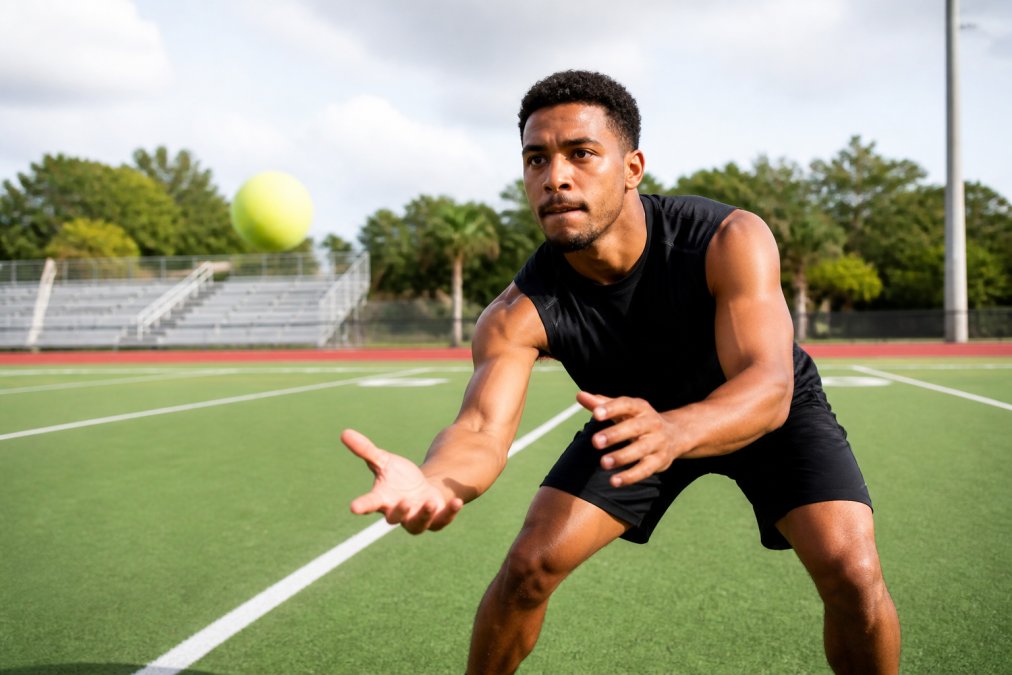
Gaze Stability and Focal Adjustment Practice
Gaze stability is the ability to keep your eyes fixed on a target while your body moves. This is essential for balance, coordination, and precise movement. A figure skater needs gaze stability while spinning. A baseball fielder needs it while running to track a fly ball. A rock climber needs it while moving their body through complex positions.
Stand with your arm extended at a distant object. Move your body, walk, turn, and bend while keeping your eyes locked on your finger. This trains the vestibulo-ocular reflex that keeps your eyes stable.
Focal adjustment is the speed of shifting focus between distances. Poor focal adjustment creates lag, blurry vision during transitions. Tennis players and golfers shift focus dozens of times per point or shot.
Hold an object at arm’s length and another farther away. Rapidly shift focus between them, minimizing blur transition time. Repeat 20-30 times with objects at different distances. This trains the ciliary muscle to respond faster.
Peripheral Awareness Exercises
Peripheral vision training teaches your brain to process information at the edges of your visual field more effectively. This is harder to train than central vision because you have to resist the urge to look directly at the peripheral target.
Sit facing forward. Have a partner stand to your side, slightly behind your shoulder. Without moving your eyes from a central point, signal when you detect movement. Gradually increase distance and speed. This trains peripheral motion detection.
Have a partner toss a ball into your peripheral vision while you focus on a central target. React to catch it without moving your eyes. This improves peripheral awareness significantly.
Run a familiar trail while maintaining focus straight ahead and noting peripheral detections. This trains real-world peripheral awareness safely. (Source: American Optometric Association’s guidelines on sports vision)
LASIK Recovery Time for Athletes
LASIK recovery depends on sport contact level. The corneal epithelium heals in 3-5 days; vision reaches 90% clarity in 1-2 weeks and full stability around 1 month.
Low-contact sports (golf, running, cycling): return in 1-2 weeks. Contact sports (basketball, soccer, martial arts): 3-4 weeks. Swimming: 4-6 weeks due to chlorine and saltwater irritation.
Recovery speed depends on how aggressively you train. Impact, sweat, and environmental stress slow healing. Schneider LASIK provides sport-specific post-operative guidance for safe return to contact activities and full training.
LASIK results are generally stable for years. Stability depends on prescription, age, and corneal characteristics.
Benefits of Vision Correction for Outdoor Sports
Eliminated visual obstruction. Glasses fog and contacts slip during intense activity. After correction, trail runners don’t adjust glasses on climbs and goalkeepers don’t lose sight due to lens movement.
Improved peripheral awareness. Glasses and contacts create subtle blind spots. Corrected vision expands your effective visual field and sharpens peripheral reliability.
Consistent depth perception. Contacts and glasses can create subtle differences between eyes. LASIK provides perfectly balanced binocular vision, sharpening depth perception and spatial judgment.
Enhanced confidence. When you trust your vision completely, you commit fully to movements and decisions.
Refractive Errors and Their Impact on Sports Performance
Myopia (nearsightedness) is the most common refractive error among athletes. You see clearly up close but struggle with distance vision. Baseball hitters struggle to track pitches, tennis players misread court position, trail runners misjudge distant terrain.
Vision Correction Options for Athletes
Athletes have multiple vision correction options. Glasses create obstruction, fogging, and peripheral distortion. Contacts eliminate obstruction but require maintenance and risk slipping during activity.
| Visual Skill | Impact on Sports | Training Method | Improvement Timeline |
|---|---|---|---|
| Dynamic visual acuity | Tracking moving objects clearly | Moving target drills, sport-specific tracking | 2-4 weeks |
| Depth perception | Spatial judgment and timing | Distance estimation drills, 3D awareness exercises | 3-6 weeks |
| Peripheral vision | Awareness of surroundings and threats | Peripheral motion detection drills, off-center focus training | 2-3 weeks |
| Gaze stability | Balance and coordination during movement | Head movement drills, vestibulo-ocular reflex training | 2-4 weeks |
| Hand-eye coordination | Reaction time and movement precision | Partner-based tracking drills, sport-specific repetition | 4-8 weeks |
Athletes often underestimate how much uncorrected vision errors degrade their performance. Even a mild refractive error creates a constant drag on reaction time and spatial judgment. Vision correction removes this drag entirely, which is why so many competitive athletes choose LASIK once they understand the impact.
Do not return to contact sports or high-impact training immediately after LASIK. The cornea is healing, and impact or trauma during the first 3-4 weeks can compromise your results. Your surgeon will provide specific timelines based on your sport and healing progress.
Frequently Asked Questions
How does vision correction improve athletic performance?
Clear vision for sports means your visual system can process movement faster, track objects more accurately, and respond with better hand-eye coordination. Refractive errors like myopia reduce dynamic visual acuity, which is critical for sports where you need to track fast-moving targets or judge depth during play. Vision correction eliminates this lag, allowing your eye-brain coordination to work at full capacity. For contact sports and outdoor activities, this translates to faster reaction times, better spatial awareness, and improved overall athletic performance.
What are the best sports vision training exercises for improving reaction time?
Effective sports vision training exercises target visual processing speed and oculomotor skills. Dynamic visual acuity drills involve tracking moving objects at varying speeds. Gaze stability exercises train your eyes to maintain focus while your head moves. Peripheral vision drills expand your visual field awareness. Contrast sensitivity training helps you see objects against complex backgrounds. Perform these exercises 3-4 times weekly for 10-15 minutes. Consistency matters more than intensity; progressive difficulty as your skills improve yields the best results for reaction time enhancement.
Is LASIK safe for athletes in contact sports?
LASIK is safe for contact sports athletes, but timing matters. Most athletes can return to non-contact training within 3-5 days and contact sports within 1-2 weeks, depending on healing and your surgeon’s clearance. The procedure itself creates a flap that fully heals within weeks, and the cornea continues strengthening for months. However, athletes in high-impact sports should discuss their specific activity with their surgeon beforehand. Protective eyewear during early recovery is essential. Once fully healed, LASIK provides stable, unaided vision without the risk of contacts dislodging during play.
Can outdoor light exposure and vision training prevent myopia progression in young athletes?
Increased outdoor light exposure and structured sports vision training, which strengthens visual processing and eye-brain coordination, may provide protective benefits. This makes outdoor sports a strategy for myopia management in developing visual systems.