



Table of Contents
- LASIK Candidacy Requirements: What Surgeons Check First
- Health Conditions That Can Disqualify You for LASIK
- Eye-Specific Reasons You May Not Qualify
- LASIK for Thin Corneas: Why the Stromal Bed Matters
- Pregnancy, Nursing, and Hormonal Fluctuations
- Alternatives to LASIK for Poor Candidates
- Getting a Second Opinion Before You Rule Yourself Out
- Frequently Asked Questions
Last Updated: September 16, 2026
LASIK Candidacy Requirements: What Surgeons Check First
What disqualifies you for LASIK? It usually comes down to a short list: an unstable prescription, a cornea that is too thin or irregularly shaped, uncontrolled systemic disease, severe dry eye, or pregnancy and nursing. Candidacy screening starts with a full pre-operative evaluation, because the goal is a safe outcome, not a quick sale.
LASIK is a refractive surgery that reshapes the cornea with a laser to correct myopia, hyperopia, and astigmatism. It works well for the right candidate. It works poorly, or not at all, for the wrong one.
Surgeons typically check four things before anything else:
- Refraction stability: Has your prescription held steady for at least a year?
- Corneal thickness and shape: Measured by corneal topography and pachymetry
- Ocular surface health: Tear film quality and dry eye syndrome status
- Systemic health: Autoimmune disease, diabetes control, medications, pregnancy status
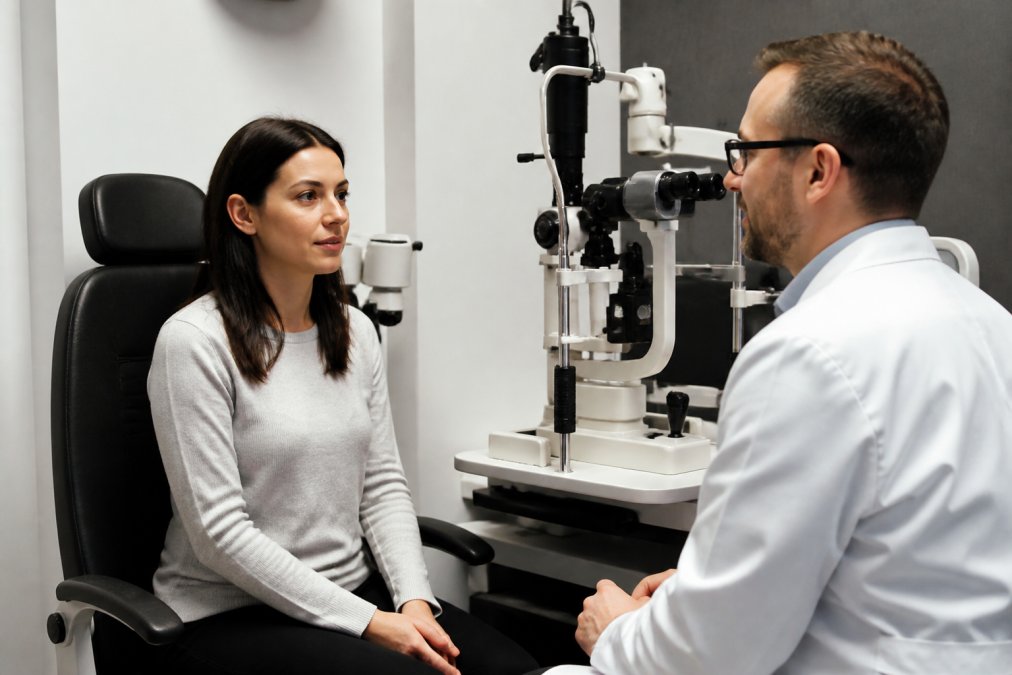
If you have been told you are not a candidate elsewhere, that is not always the end of the conversation. Below, we break down each disqualifying factor and the alternatives to LASIK for poor candidates, from PRK to EVO ICL to refractive lens exchange.
Age and Stable Prescription Rules
The minimum age for LASIK is 18, but age alone rarely decides it. The real test is a stable prescription. Most surgeons want to see your refractive error unchanged for at least 12 months before operating.
A moving prescription signals your eye is still changing. Operating on an eye that is still shifting often means you trade glasses for a second procedure later. A common mistake is rushing into surgery the month you turn 18 with a prescription that has jumped every year since you were 15.
Corneal Thickness, Topography, and Pupil Size
Corneal thickness is measured in micrometers, and it is one of the hardest limits to work around. LASIK requires creating a flap and removing tissue from the stromal bed beneath it. Remove too much, and the cornea loses structural integrity.
Corneal topography maps the surface curvature and flags irregular patterns, including early keratoconus. Large pupils matter less than they once did, but surgeons still factor them in for night vision complaints.
Health Conditions That Can Disqualify You for LASIK
Systemic health is where many would-be patients get surprised. An autoimmune disease or an immunodeficiency can affect how your cornea heals and raise the risk of post-operative complications. So can the medications used to treat them.
Autoimmune Disease, Immunodeficiency, and Medications
Conditions such as rheumatoid arthritis, lupus, and Sjögren’s syndrome can dry out the ocular surface and interfere with healing. Immunodeficiency raises infection risk. Certain medications, including some immunosuppressants and isotretinoin, may also affect candidacy or require a waiting period.
This is not an automatic no. It depends on how well controlled the condition is, which medication you take, and how your tear film looks on exam. Bring a full medication list to your consultation.
Diabetes, Blood Sugar Control, and Diabetic Retinopathy
Poorly controlled blood sugar slows wound healing and raises infection risk after any surgery. Diabetic retinopathy and fluctuating vision from unstable glucose also complicate the picture. A well-controlled diabetic with a healthy retina may still qualify; someone with active retinopathy usually should not proceed until that is addressed.
Eye-Specific Reasons You May Not Qualify
Eye conditions are the most common disqualifiers, and they are also the most nuanced. Severe dry eye syndrome, keratoconus, and a history of certain infections or injuries all change the risk profile.
Dry Eye Syndrome and Tear Film Problems
Severe dry eye is one of the most frequent reasons people are turned away. LASIK temporarily reduces corneal sensation, which can reduce tear production (pubmed.ncbi.nlm.nih.gov). If your tear film is already compromised, surgery can make dryness worse rather than better.
Mild dry eye is often manageable with treatment before surgery.
Keratoconus, Ectasia, and Other Corneal Conditions
Keratoconus is a progressive thinning and bulging of the cornea. Ectasia is a similar weakening that can occur after refractive surgery. Both are hard stops for LASIK, because removing corneal tissue in an already unstable cornea can accelerate the problem. (Source: National Eye Institute’s information on dry eye disease)
LASIK for Thin Corneas: Why the Stromal Bed Matters
LASIK for thin corneas is a legitimate concern, not a marketing talking point. The stromal bed is the layer of cornea left beneath the flap after the laser reshapes tissue. Surgeons want a minimum residual bed thickness to preserve corneal strength. When your cornea is too thin to leave an adequate bed, LASIK is off the table, but PRK or an implantable lens may not be.
The specific residual bed threshold a surgeon requires varies by practice and by your prescription. Do not assume a number you read online applies to your eye. Ask what your measured corneal thickness is and what residual bed your surgeon considers safe.
Pregnancy, Nursing, and Hormonal Fluctuations
Pregnancy and nursing are temporary disqualifiers, not permanent ones. Hormonal fluctuations can change corneal thickness, tear production, and refractive error, which makes measurements unreliable during this window. Most surgeons ask patients to wait until several months after they have stopped nursing and their prescription has stabilized again.
Alternatives to LASIK for Poor Candidates
What disqualifies you for LASIK? It does not mean disqualification from clear vision. The most common reason a patient is turned away, a thin or irregular cornea, is precisely the reason another procedure may fit better. The three main alternatives each solve a different problem, and the right one depends on your measurements, your prescription, and your age.
| Alternative | Best For | Key Difference From LASIK | Typical Recovery |
|---|---|---|---|
| PRK | Thin corneas, mild dry eye, contact-sport athletes | No flap; the surface layer is removed and regrows | Slower, vision clears over days to weeks |
| EVO ICL | High prescriptions, thin corneas, dry eye | Implantable lens; no corneal tissue removed | Fast, often same-day improvement |
| Refractive Lens Exchange (RLE) | Presbyopia, early cataracts, age 45+ | Replaces the natural lens | Fast, similar to cataract surgery |
PRK: The Flap-Free Option
PRK (photorefractive keratectomy) removes the outer epithelial layer instead of creating a flap, then applies the excimer laser to the surface. Because no flap is cut, more stromal tissue is preserved, which makes PRK a strong fit for patients whose corneas are too thin for LASIK. It is also favored by people in contact sports or military service, since there is no flap to dislodge from a direct hit.
EVO ICL: An Implantable Lens
EVO ICL (Implantable Collamer Lens) places a lens inside the eye behind the iris without removing any corneal tissue. That makes it a candidate for patients with thin corneas, high prescriptions (including some beyond the range LASIK can correct), or significant dry eye. Because the cornea is untouched, the procedure is reversible, the lens can be removed or exchanged.
Refractive Lens Exchange: For the Over-45 Eye
RLE replaces the natural lens with an intraocular lens, the same basic procedure as cataract surgery. It is the strongest option for patients over 45 who are dealing with presbyopia or early cataracts alongside their refractive error, because it addresses all three at once. It is also a path for patients whose corneas are unsuitable for laser correction.
How to Choose
The decision is not a matter of preference, it follows from your measurements. A thin cornea points toward PRK or EVO ICL. A high prescription with a healthy cornea may point toward EVO ICL. Age over 45 with early lens changes points toward RLE. A surgeon who offers a range of procedures can match the recommendation to your eye rather than steering you toward the one they happen to perform.
If you were ruled out years ago, ask what specifically disqualified you. Corneal measurements, dry eye treatments, and implantable lens options have all changed. A factor that closed the door in the past may not close it today, and if it does, one of these alternatives may be a better fit than LASIK ever was.
Getting a Second Opinion Before You Rule Yourself Out
A second opinion is not a sign of doubt; it is a standard step in good surgical decision-making. Candidacy screening involves judgment calls about borderline corneal thickness, controlled autoimmune conditions, and dry eye severity. Two experienced surgeons can reasonably reach different conclusions.
Frequently Asked Questions
Can thin corneas disqualify me from LASIK surgery?
Yes, corneal thickness is one of the most common reasons people are turned down. LASIK involves creating a flap and removing tissue from the stromal bed, so surgeons need enough remaining cornea to keep the eye stable. If your corneas are too thin, you may still qualify for PRK or another procedure that does not require a flap. A corneal topography scan during your pre-operative evaluation will show exactly where you stand.
How do autoimmune diseases affect LASIK eligibility?
Conditions like rheumatoid arthritis, lupus, and Sjogren’s syndrome can affect how your eyes heal and may worsen dry eye syndrome, which is a key disqualifier. Some immunosuppressive medications also interfere with recovery. That does not automatically rule you out, but your surgeon will want your condition well controlled and may ask for clearance from your rheumatologist. In some cases, an alternative like EVO ICL is a better fit.
Can I get LASIK if I have dry eye syndrome?
Mild dry eye often does not disqualify you, but moderate to severe cases usually do. LASIK temporarily reduces corneal sensation, which can make tear film problems worse. Your pre-operative evaluation will measure tear production and ocular surface health. If your dry eye is significant, your surgeon may recommend treating it first, or suggest PRK or another option that puts less stress on the ocular surface.
Is there an age limit for LASIK surgery?
Most surgeons require patients to be at least 18, and many prefer 21 or older. The bigger issue is prescription stability. Your refractive error should be unchanged for at least a year before surgery. There is no hard upper age limit, but adults over 40 often face presbyopia, and those over 60 may have cataracts or other conditions that make refractive lens exchange a better choice than LASIK.