


Last Updated: October 29, 2026
Quick Summary
A pediatric eye exam typically follows six steps: health and family history, visual acuity testing, a refraction test, eye alignment and binocular vision checks, an ocular health check, and dilation when needed. Dilation drops take 30 to 45 minutes to fully work, so plan for a longer visit and bring sunglasses for the ride home.
- Only 39.5% of children under 18 have received an eye exam, leaving most kids without real assessment.
- A vision screening only flags possible problems, while a comprehensive exam finds and diagnoses them.
- Bring sunglasses and plan a quiet afternoon if dilation is planned for the visit.
- Ask the front desk whether dilation is planned and book a morning slot if it is.
- Comprehensive eye exams can begin as early as 6 months of age.
Table of Contents
- Why a Pediatric Eye Exam Matters More Than You Think
- Comprehensive Eye Exam vs Vision Screening: What’s the Difference
- Signs of Vision Problems in Children You Shouldn’t Ignore
- What Happens During a Pediatric Eye Exam, Step by Step
- Pediatric Eye Exam Duration: How Long Each Part Takes
- Preparing Child for Eye Doctor: A Simple Checklist
- Sensory-Friendly Exam Techniques and Cost Transparency
- Schedule Your Child’s Eye Exam Consultation
- Frequently Asked Questions
Why a Pediatric Eye Exam Matters More Than You Think
A pediatric eye exam is a full check of how well a child’s eyes work and how well they work together, not just a quick reading of letters on a wall.
The numbers explain why. According to reporting on pediatric eye care access, only 39.5% of children under 18 have received an eye exam.
Vision and eyesight are not the same thing.
Early detection matters: strabismus, amblyopia, and significant refractive error are generally easier to address when found early.
Comprehensive Eye Exam vs Vision Screening: What’s the Difference
A vision screening is a quick check designed to flag kids who might have a problem.
The NIH Pediatric Eye Evaluations Preferred Practice Pattern defines vision screening as an evaluation to detect reduced visual acuity or risk factors that threaten the healthy growth and development of the eye.
A comprehensive eye exam covers far more ground:
- Visual acuity with age-appropriate tools
- Refraction test to measure the exact prescription
- Eye alignment and binocular vision checks
Screening happens at school, at the pediatrician’s office, or at a health fair. It takes minutes and often uses a photo device or a letter chart.
So who should do the full exam? If you’re unsure which fits your situation, this guide on choosing an eye doctor in Rancho Cucamonga breaks down the difference.
Signs of Vision Problems in Children You Shouldn’t Ignore
Some vision problems announce themselves. Others hide behind good grades and a cooperative personality. Watch for these signs of vision problems in children, because kids rarely say “my eyes don’t work right.”
Behavioral signs:
- Eye rubbing, especially after reading or screen time
- Frequent blinking or squinting
- Tilting the head or covering one eye to see
Physical signs:
- One eye that turns in, out, up, or down (possible strabismus)
- Eyes that don’t appear to track together
- Redness, watering, or crusting
School and play signs:
- Falling behind in reading despite effort
- Trouble with hand-eye coordination and sports
- Complaints of headaches after close work
A common mistake is waiting for a teacher to raise a concern. Teachers see hundreds of kids and miss subtle cues. You see your child every day, so trust your gut and book an exam if something feels off.
What Happens During a Pediatric Eye Exam, Step by Step
Most pediatric eye exams follow the same basic path, adjusted for your child’s age.
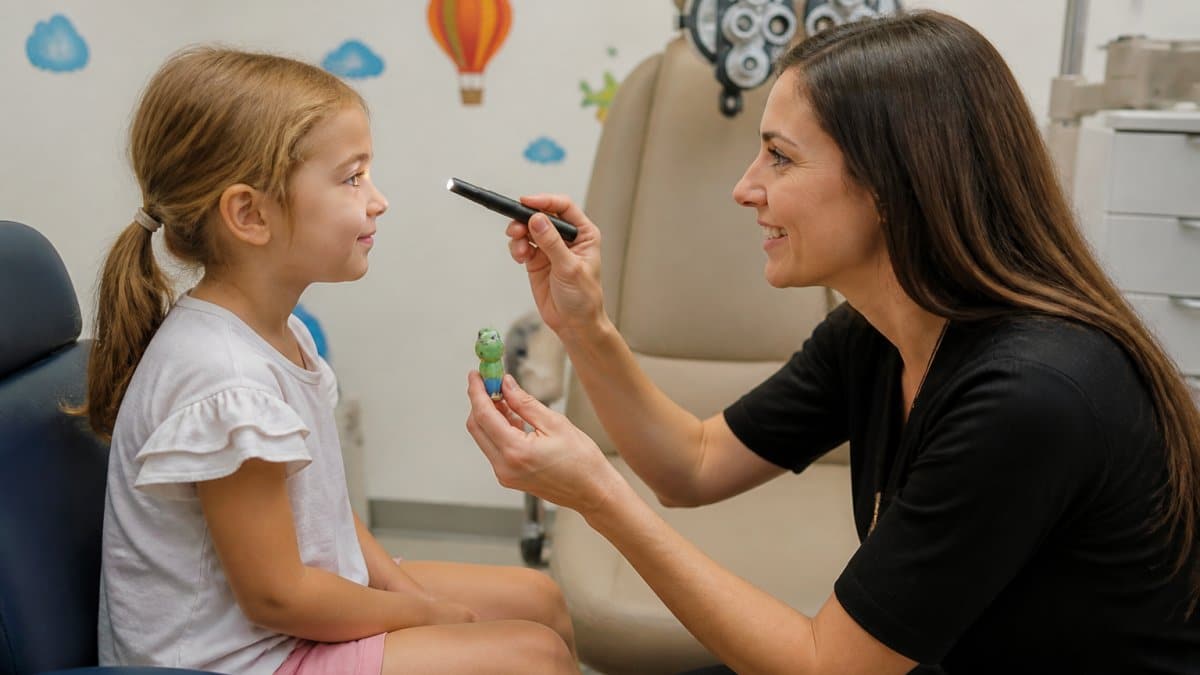
**1. Recent guidance from Aspire Vision Care’s pediatric eye care overview notes that exams now frequently open with this developmental discussion.
2. Visual acuity testing. Your child reads letters, matches shapes, or identifies pictures, depending on age.
3. Refraction test. The provider measures the exact prescription using a retinoscope or an automated device.
**4.
5. Ocular health check. A light and magnifier examine the front of the eye, and often the retina at the back.
**6.
The Dilation Step and Why It Takes Time
Dilation is the step parents ask about most. The drops themselves take seconds.
According to University of Florida Ophthalmology’s pediatric appointment guide, dilation typically takes 30 to 45 minutes to fully work.
Why dilate at all? Dilating drops relax the focusing muscle inside the eye.
Plan for it. Bring sunglasses for the ride home, since kids are light-sensitive for a few hours after.
Ask the front desk when you book whether dilation is planned for this visit. If it is, schedule the appointment for a morning slot so the blur wears off before bedtime, and bring a wide-brimmed hat as a backup to sunglasses.
Age-by-Age Variations in the Exam
The same six steps look different depending on your child’s age, and knowing that in advance keeps you from worrying when the visit doesn’t match a friend’s experience.
- Infants and toddlers (6 months to 3 years): Most of the exam is observation-based. The provider watches fixation and following, uses retinoscopy for refraction, and checks alignment with a cover test or light reflex test. Your child may sit on your lap the entire time.
- Preschoolers (3 to 5 years): Symbol or picture acuity charts become usable. The provider may use a matching game where your child points to a symbol on a card that matches the one on the wall. Alignment and stereo testing are usually cooperative at this age.
- School-age children (6 and up): Letter charts, standard refraction, and full binocular vision testing are usually possible. The provider will also ask more directly about reading, screen use, and headaches after close work.
If your child has a developmental delay, is nonverbal, or has a known diagnosis such as autism, tell the scheduler when you book. The provider can plan a longer slot and choose instruments and approaches that don’t depend on verbal responses.
What to Bring and What to Ask
A short list makes the visit smoother and the answers more useful:
- Insurance card and photo ID
- Any prior eye records, glasses, or contact lens prescriptions
- A list of medications and known allergies
Ask the provider at the end of the visit: What did you find, and how does it compare to age norms? Does my child need glasses now, or are we watching something? When should we come back, and what would make you want to see us sooner? Those three answers turn a single appointment into a plan.
Pediatric Eye Exam Duration: How Long Each Part Takes
Visit length varies with the child’s age, cooperation, and whether dilation is needed, so ask the office what to expect when you book.
| Exam Stage | Typical Time | Notes |
|---|---|---|
| Check-in and history | 10-15 min | Longer for first visits |
| Visual acuity testing | 10-15 min | Depends on child’s age and cooperation |
| Refraction test | 10-15 min | Faster with automated devices |
| Alignment and binocular checks | 10-15 min | Tracking, coordination, depth perception |
| Ocular health exam | 5-10 min | Light and magnifier |
| Dilation wait | 30-45 min | Drops take time to work |
| Dilated exam and wrap-up | 15-20 min | Prescription, plan, questions |
First exams with a toddler or an anxious preschooler run longer. That’s expected. Providers build in extra time for young kids, and a calm pace beats a rushed one.
Preparing Child for Eye Doctor: A Simple Checklist
Preparing a child for the eye doctor starts days before the appointment. Kids handle unfamiliar situations better when they know what’s coming. Use this checklist.
- Talk about it in plain terms. “The doctor will shine a light and ask you to look at pictures.” Skip words like “test” and “shot.”
- Read a book or watch a short video about visiting the eye doctor.
- Schedule wisely. Morning slots work best for young kids. Avoid nap time and mealtime.
One insider tip: tell the front desk if your child has sensory sensitivities or anxiety before the visit. According to Pacific University’s pediatric eye care report, practitioners use toys, pictures, and friendly tones of voice to conduct exams for infants and young children.
Sensory-Friendly Exam Techniques and Cost Transparency
Two things separate a smooth pediatric visit from a stressful one: how the exam is delivered and what it costs.
Sensory-Friendly Techniques That Actually Work
Many parents worry about a child who is anxious, sensitive to light or sound, or neurodivergent. Pediatric eye care has adapted, and most of the accommodations below cost nothing and require only a heads-up.
What to ask for when you book:
- A longer slot. Tell the scheduler your child needs extra time. A 60-minute slot instead of 30 lets the provider move at your child’s pace.
- A quiet room or a low-traffic time. First appointment of the morning or right after lunch often means a calmer waiting room.
- Dimmed lighting in the exam room on request. Fluorescent overheads are a common trigger.
Ask for these. A good pediatric team offers them without being asked, but speaking up helps. If your child has a diagnosis such as autism, ADHD, or a sensory processing difference, say so at booking; the team can choose instruments and approaches that don’t depend on verbal responses or prolonged stillness.
Bring a comfort item and a pair of sunglasses from home. The comfort item helps in the waiting room, and the sunglasses are useful after dilation even if the office provides a pair.
Cost Transparency: What to Ask Before You Book
Pediatric eye exams are often covered in part by vision insurance or health insurance, but coverage varies widely by plan.
Three questions to ask your insurance plan before the visit:
- Is this exam billed as medical or vision? A medical exam (for example, one prompted by an eye turn, an infection, or a headache) may run through health insurance; a routine vision exam usually runs through a separate vision plan. The two can have different copays and networks.
- What’s my copay or coinsurance, and does it apply to dilation or extra testing? Dilation is usually part of the exam, but some plans treat certain tests separately.
- Is the provider in network for both my medical and vision plans? A provider can be in network for one and out for the other.
Get the answer in writing or by email if you can.
Questions to ask the practice when you book:
- What will this visit cost me out of pocket, assuming my plan covers the exam?
- Do you bill medical or vision for a routine pediatric exam?
- Is there a self-pay rate if I’m paying cash, and what does it include?
For families paying out of pocket, ask about self-pay rates upfront. Many practices publish them or will quote them over the phone.
A school vision screening is not a substitute for a comprehensive exam, and it is not billed the same way. If your child failed a school screening, tell the scheduler, that detail can affect how the visit is coded and what your plan covers.
Putting It Together
A smooth visit is mostly preparation: tell the team what your child needs, ask what the visit will cost before you arrive, and bring the records and questions that make the appointment useful.
Schedule Your Child’s Eye Exam Consultation
The best time to book a pediatric eye exam is before a problem shows up.
Comprehensive eye exams for children can begin as early as 6 months of age, with follow-ups recommended between 6 and 12 months and again between 3 and 5 years, according to UnitedHealthcare’s age-by-age vision guide. After that, annual check-ups keep pace with a child’s growing visual system.
Schneider LASIK provides vision care across Southern California. You can meet the doctors and confirm which clinic location serves your family. To learn more about the team and book a consultation, visit our website.
A pediatric eye exam is one appointment. Clear vision for school, sports, and everything else lasts a lot longer.
Frequently Asked Questions
How long does a pediatric eye exam take?
Visit length varies with the child’s age and cooperation, and dilation adds waiting time before the doctor can check the back of the eye. Plan for a longer visit than a school screening. Bring snacks, a favorite toy, and a stroller or carrier for younger children so the wait stays calm. Ask the front desk when scheduling whether dilation will be part of the visit.
How do doctors test the eyesight of toddlers who cannot read yet?
Pediatric eye doctors use picture charts, matching cards, and preferential looking tests instead of letter charts. For infants and toddlers, the doctor watches how the child’s eyes follow a moving toy or light, checks eye alignment, and uses handheld instruments to measure how light bends inside the eye. These techniques give a reliable picture of visual acuity and eye coordination without requiring the child to read or speak.
What is the difference between a school vision screening and a comprehensive eye exam?
A vision screening is a quick check that flags reduced visual acuity or risk factors, per the NIH. It does not diagnose. A comprehensive eye exam by a pediatric optometrist or ophthalmologist checks ocular health, refraction, binocular vision, depth perception, and eye alignment in detail. Screenings miss conditions like amblyopia and strabismus that a full exam catches. If a screening flags anything, schedule a comprehensive exam.
At what age should a child have their first comprehensive eye exam?
Comprehensive eye exams can begin as early as 6 months of age, with recommended visits between 6 and 12 months and again between ages 3 and 5, according to general pediatric eye care guidance. After that, annual check-ups help track visual development through school years. Children with a family history of strabismus, amblyopia, or early glasses use may need earlier or more frequent visits.
Your child’s eyes change fast, and a single exam gives you a baseline you can build on. Schneider LASIK offers state-of-the-art exam technology, a highly experienced medical team, and customized care based on your child’s age, prescription, and lifestyle. Get started with Schneider LASIK and give your child the clear vision they need to learn, play, and grow with confidence.