


Last Updated: October 29, 2026
Quick Summary
Refractive lens exchange candidacy for seniors depends on eye health, not age, since no formal upper age limit exists for a healthy eye. Your surgeon evaluates prescription stability, overall health and medications, ocular surface and retinal health, and your ability to follow recovery instructions.
- Most refractive lens exchange patients are over 45, and many are in their 50s and 60s.
- Bring your recent prescriptions and a written list of every medication and supplement to your evaluation.
- Alpha-blockers like tamsulosin must be disclosed because of their link to floppy iris syndrome.
- A dilated retinal exam is important for high myopia, which carries higher retinal risk over time.
- If a cataract is close, waiting can mean one recovery instead of two.
Table of Contents
- Why Refractive Lens Exchange Candidacy Is About Eye Health, Not Age
- Is There a Refractive Lens Exchange Age Limit for Seniors?
- The Senior-Specific Candidacy Requirements That Decide Suitability
- What an RLE Candidacy Evaluation Actually Involves
- RLE vs LASIK for Seniors: Which Fits an Older Eye?
- Refractive Lens Exchange With Cataracts: One Surgery or Two?
- Realistic Outcomes and Lens Trade-Offs for Older Patients
- Scheduling Your RLE Candidacy Consultation
- Frequently Asked Questions
Why Refractive Lens Exchange Candidacy Is About Eye Health, Not Age
Refractive lens exchange candidacy requirements for seniors come down to the health of your eye, not the number of birthdays you’ve had. Refractive lens exchange, or RLE, is a procedure that replaces your eye’s natural lens with an artificial intraocular lens, called an IOL. Candidacy for refractive lens exchange is generally evaluated through diagnostic testing, not assumptions about age.
That distinction matters. Many older adults assume they’ve aged out of vision correction. The opposite is often true.
Age alone does not establish candidacy. Eye health does. If you want the full overview of how the procedure works before judging your own suitability, you can learn more about Refractive Lens Exchange.
Is There a Refractive Lens Exchange Age Limit for Seniors?
No formal upper age limit exists for lens replacement in a healthy eye. Clinical guidance from OVO Eye’s overview of RLE candidacy after 40 states that candidacy after 40 depends on eye health, not chronological age.
Most RLE patients are over 45. Many are in their 50s and 60s. Some are older.
Refractive lens exchange replaces the natural crystalline lens with an artificial intraocular lens (IOL).
The takeaway: there is generally no age limit that rules a patient out automatically. Eye health is the standard that shapes candidacy.
The Senior-Specific Candidacy Requirements That Decide Suitability
Several factors carry extra weight for older patients. Each one is checkable before surgery, and each one shapes the recommendation. The sections below cover the criteria that most often decide candidacy in patients over 60, including the health and medication issues that general RLE guides tend to skip.
Refractive Stability and Prescription History
Your prescription generally needs to be stable before surgery, and your surgeon will review how it has changed over time.
Why does this matter? A shifting prescription can signal an eye still changing. Surgery on a moving target produces a less predictable result. Bring your glasses and contact lens prescriptions from the past few years to your evaluation. If your prescription has changed because of a developing cataract rather than a true refractive shift, that is a different conversation, and it may point toward cataract surgery instead.
Overall Health, Medications, and Healing Capacity
Age alone does not disqualify anyone, but the health conditions that become more common with age do affect the plan. Surgeons generally want to know about conditions such as diabetes, autoimmune disease, and bleeding disorders, since these can affect healing.
Medications deserve their own review. Your surgical team needs to know about any blood thinners you take and will coordinate with your prescriber on timing.
Mobility and support matter too. You will need a ride home and help for the first day or two after surgery. If you live alone or have limited transportation, raise it at the consultation so the team can help you plan.
Ocular Surface Health and Competing Eye Conditions
Dry eye and other surface problems can distort measurements and slow recovery. So can conditions like glaucoma or macular disease. These do not always rule out RLE, but they change the plan.
A common mistake is skipping dry-eye treatment before surgery. Treating the surface of the eye before surgery can be part of the plan, and your surgeon will advise you. If you have glaucoma, your surgeon will want to confirm the pressure is controlled and discuss whether the disease affects your target vision.
Retinal Risk Assessment for High Myopia
High myopia deserves its own conversation. Highly nearsighted eyes are longer and carry higher retinal risk over time. That risk exists with or without surgery, but it belongs in the candidacy discussion.
A thorough retinal examination is an important part of the evaluation for this group. Your surgeon will look at axial length, review any history of retinal tears, lattice degeneration, or prior retinal treatment, and may recommend a dilated exam with scleral depression. If you have high myopia, ask directly how your retina was assessed and whether any findings change the timing or the lens choice. A quick self-check of your own candidacy factors is a useful first step:
For seniors, candidacy is decided by a combination of prescription stability, overall health and medications, ocular surface and retinal health, and your ability to participate in recovery. Bring a medication list and your recent prescriptions to the evaluation.
What an RLE Candidacy Evaluation Actually Involves
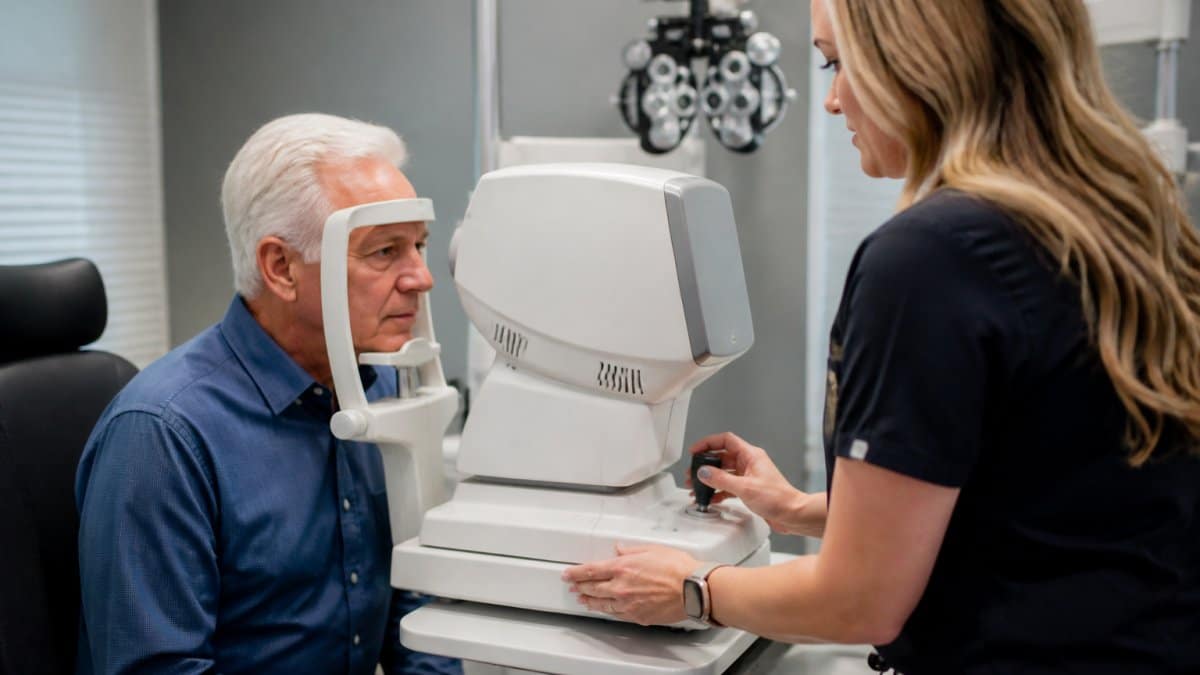
An RLE candidacy evaluation is a diagnostic workup, not a sales conversation. It measures your eye, checks its health, and matches the findings to your visual goals. For older patients, the workup also screens for the age-related conditions that can change the recommendation.
Here is what a thorough preoperative evaluation typically includes, and why each step matters:
- Visual acuity testing at distance and near, with and without correction. This establishes your baseline and shows how much you rely on glasses for daily tasks.
- Refraction to confirm your current prescription. Your surgeon compares it with prior prescriptions to judge stability.
- Corneal topography and measurements to map the surface of your eye. This detects irregular astigmatism and conditions like keratoconus that can affect lens choice or rule out certain options.
- Biometry to measure eye length and calculate lens power. Axial length is especially important in high myopia, where it informs both lens calculation and retinal risk.
- A dilated retinal examination to check the back of the eye. This looks for macular disease, retinal tears, lattice degeneration, and other findings that may change timing or expected outcomes.
- Ocular surface assessment for dry eye and other surface problems. Uncontrolled dry eye can skew measurements and worsen postoperative comfort, so treatment may be recommended before surgery.
- A review of your prescription history to confirm stability, along with a review of your medication list and overall health.
- A conversation about lens options and what you expect from surgery, including a frank discussion of night-vision symptoms, reading glasses, and the trade-offs of monofocal, multifocal, and toric lenses.
Industry commentary from Brinton Vision (2026) makes the point plainly: candidacy should rest on objective diagnostic testing, not subjective criteria. If an evaluation feels rushed, that is a signal.
Bring three things to your evaluation: your current glasses and contact lens prescriptions, a written list of every medication and supplement you take, and a note about which daily activities matter most to you. Those three items shape the recommendation as much as any measurement.
RLE vs LASIK for Seniors: Which Fits an Older Eye?
For many patients over 50, RLE may fit an older eye better than LASIK. Here is why. LASIK reshapes the cornea. RLE replaces the lens.
The American Refractive Surgery Council’s overview of refractive lens exchange describes RLE as a procedure for people who may not be good candidates for laser vision correction.
Neither source establishes a universal rule. The right choice depends on your lens, your cornea, and your goals.
| Factor | RLE | LASIK |
|---|---|---|
| What changes | The lens is replaced | The cornea is reshaped |
| Best fit | Age-related lens changes, high prescriptions | Stable prescription, healthy cornea |
| Reading glasses | May be reduced with a multifocal lens | Typically still needed after 40 |
| Cataract prevention | Natural lens is removed | Lens remains and can still cloud |
The honest limitation: RLE is a bigger procedure than LASIK. It is still eye surgery, with real risks and a recovery period. We recommend it when the lens is the problem, not as a default.
Refractive Lens Exchange With Cataracts: One Surgery or Two?
Refractive lens exchange with cataracts is often one surgery, not two. Both procedures replace the natural lens with an IOL. The difference is timing and intent.
If your lens is already clouding, the surgery is typically handled as cataract surgery with a premium lens.
Dr. David F. Chang, speaking in Ophthalmology Times’ coverage of AAO 2026, emphasized setting realistic visual expectations with refractive IOLs. That counseling matters more than the label on the procedure.
Some patients ask whether waiting for a cataract is smarter. Sometimes it is. For details on how we handle lens clouding, see our information on cataract care in Corona.
Realistic Outcomes and Lens Trade-Offs for Older Patients
No lens gives perfect vision at every distance. That is the trade-off every candidate needs to hear before surgery.
- Monofocal lens: sharp distance vision, usually with reading glasses for near work
- Multifocal lens: a range of distances, with possible halos or glare at night
- Toric lens: corrects astigmatism alongside the prescription
Visual experience varies between people. Some adapt to multifocal lenses, while others notice night-time visual effects. A common mistake is choosing a lens based on someone else’s result rather than your own daily visual needs.
What most guides miss is the recovery side. Follow-up visits matter, and so does planning. Arrange help for the first day or two, and expect to pause strenuous activity for a short period. If cost is part of your decision, our page on refractive lens exchange cost for presbyopia walks through what to expect.
Scheduling Your RLE Candidacy Consultation
The only way to know whether you meet refractive lens exchange candidacy requirements for seniors is a proper evaluation. Age will not decide it. Your eye health, prescription history, and visual goals will.
At Schneider LASIK, our team uses diagnostic testing and a customized plan based on your age, prescription, and lifestyle. Mark Schneider, M.D., has been named a ‘Top Ophthalmologist’ seven times by the Consumers Research Council of America.
A common risk is delaying an evaluation because you assume you are too old.
Schedule your consultation to learn what your eyes are candidates for. You can submit the form to schedule a vision correction consultation with the team.
Frequently Asked Questions
Does insurance cover refractive lens exchange?
Most vision and health plans treat refractive lens exchange as an elective procedure when it is done purely to reduce glasses dependence, so it is usually paid out of pocket. When a cataract is already present and the surgery is medically necessary, part of the cost may be covered, but the upgrade to a premium lens often carries an additional charge. Ask your plan directly and request a written estimate before scheduling. Schneider LASIK’s website has pricing information, and financing options are available.
How old do you have to be to get lens replacement surgery?
There is no formal upper age limit for lens replacement in a healthy eye. Candidacy after 40 depends on eye health and visual needs rather than a birth year. Most refractive lens exchange patients are over 45, and the procedure is often considered for people in their 50s and 60s whose lens has started to lose flexibility. A comprehensive eye examination, not a chronological threshold, determines whether the procedure is appropriate for you.
What disqualifies you from being a refractive lens exchange candidate?
Common disqualifiers include an unstable prescription that has changed within the last two years, uncontrolled glaucoma, significant macular disease, active infection or severe dry eye, and a cornea or retina that cannot support the planned lens. Unrealistic expectations about reading vision also matter, since multifocal lenses involve trade-offs such as halos at night. A full preoperative evaluation, including corneal topography and a dilated retinal examination, is what separates suitable candidates from those who should wait.
Can seniors with cataracts have refractive lens exchange?
Yes. Refractive lens exchange uses the same surgical steps as cataract surgery: the natural lens is removed and replaced with an intraocular lens. When a cataract has already formed, the procedure is typically billed and scheduled as cataract surgery with a refractive lens upgrade. The candidacy requirements do not change, but the conversation shifts to which lens option best matches your reading, distance, and night-driving needs.