


Last Updated: November 18, 2026
Quick Summary
EVO ICL can treat a labeled range of nearsightedness, but the published numbers vary by source and lens model. Your own eligibility depends on your eye anatomy and whether your prescription is stable, so a licensed eye-care professional must confirm the evo icl prescription range for you.
- Published EVO ICL myopia ranges differ across sources, so check labeling for your specific lens model.
- The spherical EVO ICL does not correct astigmatism; a separate toric lens option is used.
- A 2026 company estimate says about 24 million U.S. adults with myopia may be potential candidates.
- Your eye anatomy and prescription stability decide eligibility, not the headline range alone.
- Ask your surgeon whether your goal is full correction or partial reduction before surgery.
Table of Contents
- EVO ICL Prescription Range: The Basic Numbers
- Full Correction Versus Partial Reduction of High Myopia
- EVO ICL Astigmatism Correction Range and Toric Options
- How to Read Your Glasses Prescription for ICL Eligibility
- EVO ICL Candidacy Requirements Beyond the Prescription
- EVO ICL vs LASIK for High Myopia
- How Long EVO ICL Lasts and Booking Your Personal Evaluation
- Frequently Asked Questions
EVO ICL Prescription Range: The Basic Numbers
If you are asking what EVO ICL prescription range can be corrected, the honest answer has two layers. The first layer is the labeled range, what the device is approved to treat. The second layer is your individual eligibility, what your eye anatomy and prescription stability allow. Published figures differ across sources because they mix these two layers, so the number on a brochure is not the final word. A licensed eye-care professional decides whether you qualify.
The key point is that the headline range describes what the lens may treat in general, not what it will treat for you.
A 2026 company estimate from STAAR Surgical says about 24 million U.S. adults with myopia may be potential EVO ICL candidates (STAAR Surgical 2026 company estimate of potential EVO ICL candidates). That figure describes potential candidates, not people who have been evaluated or treated.
The labeled myopia range, in diopters
Diopters (D) are the unit eye doctors use to measure prescription strength. A higher absolute number means a stronger prescription. For nearsightedness (myopia), the numbers carry a minus sign.
- Spherical EVO ICL for myopia: the published labeling ranges are not uniform across sources, so check the current labeling for the lens model with your eye care professional.
Why the published ranges differ
A common pattern is that three different things get quoted as if they were one:
- Device labeling, the specific indications the FDA approved for a specific lens model.
- Lens model differences, EVO and EVO+ are distinct generations with their own labeling, and a range that applies to one does not automatically apply to the other.
- Clinic summaries, many practices quote the widest range they have seen used, which may include partial correction or off-label cases.
When you see -15.0 D in one place and -20.0 D in another, the question to ask is: full correction or partial reduction, and which lens model? That distinction is covered in the next section.
What the range does not tell you
A prescription inside the labeled range is necessary but not sufficient. Your exact prescription, eye anatomy and health all shape eligibility. Two people with the same -9.0 D prescription can get different answers because the space inside the eye, the corneal endothelium, and prescription stability differ.
- Nearsightedness (myopia) is the most common reason people are considered
- Astigmatism is treated with a separate toric lens option
- Your exact prescription, eye anatomy and health all shape eligibility
Watch out: treating the headline range as a yes/no test is the most common mistake. A prescription at -16.0 D does not automatically disqualify you, and a prescription at -4.0 D does not automatically qualify you.
The table below summarises the key numbers and distinctions covered in this section, so you can compare them at a glance.
| Item | Value | Note |
|---|---|---|
| Potential U.S. adult myopia candidates | About 24 million | 2026 company estimate; potential, not evaluated |
| Labeled myopia range | Varies by source | Check current labeling for the lens model |
| Range layers | Labeled range vs. individual eligibility | Eye anatomy and prescription stability decide |
| Prescription sign for myopia | Minus sign | Higher absolute number means stronger prescription |
| Astigmatism treatment | Separate toric lens option | Spherical EVO ICL does not correct astigmatism |
Full Correction Versus Partial Reduction of High Myopia
Full correction means the lens is intended to bring your vision close to clear without glasses. Partial correction means it reduces the prescription, but you may still need glasses for some tasks.
These two outcomes are easy to confuse, and the difference matters.
Watch out: a lower-than-expected reduction does not mean the procedure failed. Discuss your realistic goal with your surgeon before the lens is placed.
EVO ICL Astigmatism Correction Range and Toric Options
Astigmatism is a curvature problem in the eye that blurs vision at all distances. Learn how astigmatism is measured and corrected before you compare toric lens details. It is measured in diopters of cylinder, and it is treated with a separate toric lens option, the EVO Toric ICL, sometimes written as EVO TICL. The spherical EVO ICL does not correct astigmatism; the toric version does.
Why you see both 2.5 D and 4.0 D
The number that matters for you is the one attached to the lens model your surgeon plans to use. Confirm the labeled astigmatism limit for that model with your eye care professional.
How toric correction actually works
A toric lens has different optical power in different meridians, and it must be aligned to the axis of your astigmatism. Your cylinder and axis are measured during the preoperative exam, not taken from your glasses prescription alone.
The astigmatism numbers to bring to your evaluation
When you look at your prescription, the cylinder value is the astigmatism number, and the axis is its orientation in degrees. A prescription showing -1.50 cylinder at 90 degrees is a different surgical plan than -1.50 cylinder at 180 degrees, even though the cylinder number is identical.
- Bring your current glasses or contact lens prescription, including cylinder and axis
- Ask which toric lens model your surgeon uses and what its labeled cylinder limit is
- Ask whether any residual astigmatism would be left intentionally and what that means for glasses use
Watch out: a cylinder value above a quoted limit does not automatically rule out ICL. It may mean a different lens model, a partial correction plan, or a combination approach, but only a measured exam can tell you which.
How to Read Your Glasses Prescription for ICL Eligibility
Your glasses prescription lists sphere, cylinder and axis values. Sphere reflects nearsightedness or farsightedness, cylinder reflects astigmatism, and axis shows the orientation of that astigmatism.
Eye doctors also look beyond these numbers. A prescription that has changed recently may need to stabilize before a lens is considered, and factors such as corneal thickness and the space inside the eye also matter.
- Bring your current glasses or contact lens prescription to your evaluation
- Note how long your prescription has been stable
- Ask which measurements the surgeon uses to decide eligibility
EVO ICL Candidacy Requirements Beyond the Prescription
Prescription range is only one part of candidacy. The FDA labeling for EVO ICL includes an age indication for U.S. patients, and a 2026 STAAR Surgical release says the FDA expanded that indication to patients ages 21 to 60 (STAAR Surgical release on FDA age indication expansion for EVO ICL).
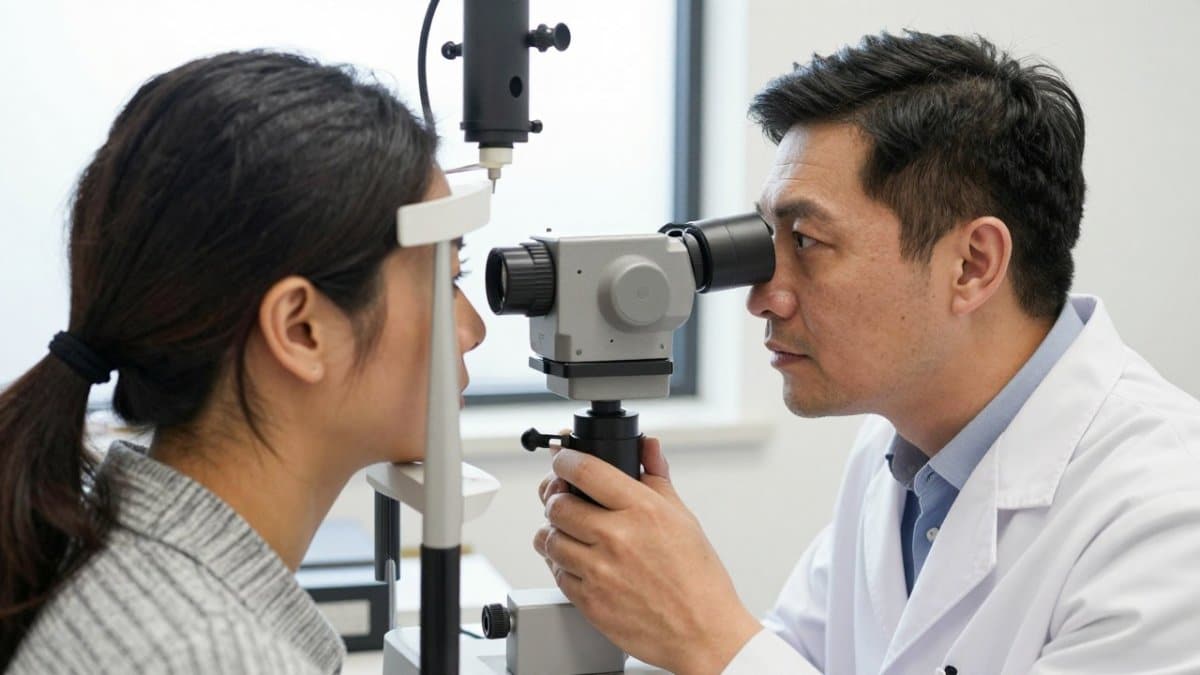
Other factors commonly reviewed in a preoperative evaluation include eye health, how stable your vision is, and whether your eyes are suited to an implanted lens. A patient who is not a good candidate for ICL may still have other options, including refractive lens exchange.
Eye surgery is never risk-free, so an honest consultation matters more than a quick yes or no.
EVO ICL vs LASIK for High Myopia
LASIK reshapes the cornea with a laser, while EVO ICL places a lens inside the eye without removing corneal tissue. That difference is why some people with high myopia are steered toward one procedure over the other.
A 2024 study in PubMed Central looked at refractive outcomes of EVO and EVO+ ICL as an alternative to laser vision correction, and it is worth reading the full paper for its findings (2024 PubMed Central study on refractive outcomes of EVO and EVO+ ICL versus laser vision correction).
The right choice depends on your corneal thickness, your prescription and your goals. Your surgeon can compare both options for your eyes.
How Long EVO ICL Lasts and Booking Your Personal Evaluation
EVO ICL is designed as a implantable lens, and a 2024 case report describes a patient who returned about 20 years after an ICL was implanted for a refractive lens exchange (Case report on a 20-year ICL reversibility follow-up). Long-term results still vary, so ask your surgeon about follow-up care.
To find out whether EVO ICL fits your prescription and eyes, schedule a virtual consultation or review the doctors at Schneider LASIK.
Frequently Asked Questions
How much astigmatism can EVO ICL correct?
Published astigmatism limits for EVO ICL vary by source and lens model. Because these published figures differ, the labeling for the specific lens type and an eye care professional’s assessment of your own prescription should guide any decision. A toric EVO ICL is designed for astigmatism, and your eye doctor can confirm whether your measurements fall within the range for your lens.
Does EVO ICL give you 20/20 vision?
Vision outcomes vary by person, so no surgeon can promise 20/20 vision for every patient. Results depend on the prescription being treated, the lens selected and individual healing. A preoperative evaluation can help estimate what is realistic for your eyes, and your eye care professional can explain expected outcomes before any decision is made.
Is EVO ICL riskier than LASIK?
EVO ICL and LASIK are different procedures, and they suit different eyes. EVO ICL places a lens inside the eye and does not reshape the cornea, which makes it an option for some people with high myopia whose corneas are not suitable for LASIK. Each procedure carries its own risks, including the need for follow-up care. Whether one is safer for you depends on your eye measurements and health, so the choice should be made after a comprehensive consultation.
What prescription range can EVO ICL correct?
Published ranges for EVO ICL nearsightedness differ by source, so treat any single number with caution. The applicable range depends on the lens type and your astigmatism. Your eye doctor can compare your glasses prescription with the labeled limits and explain whether EVO ICL is appropriate for your eyes.