


Last Updated: November 14, 2026
Quick Summary
EVO ICL lenses are designed to remain in place for the long term, but the eye around them keeps changing with age. The implant keeps correcting your refractive error while your natural lens continues to age, so presbyopia and cataracts can still develop and may need separate treatment later.
- In February 2026, the FDA expanded the U.S. age indication for EVO ICL to patients ages 21 to 60.
- Presbyopia typically begins between ages 40 and 45 as the natural lens loses elasticity.
- Many patients still need reading glasses in their mid-40s and beyond, which is expected.
- An EVO ICL does not prevent cataracts, and the implant usually has to come out if one develops.
- Report a sudden vision change in one eye to your surgeon rather than waiting for your next visit.
Table of Contents
- The Lens Stays, Your Eyes Keep Changing
- How Long Does EVO ICL Last?
- A Timeline of Age-Related Changes After Implantation
- EVO ICL and Presbyopia: When Near Vision Shifts
- EVO ICL and Cataracts: What Happens When the Natural Lens Clouds
- EVO ICL Lens Removal or Replacement: Your Options
- Age Eligibility and Stable Prescription Requirements
- Monitoring Symptoms and Follow-Up Care Over the Years
- Frequently Asked Questions
The Lens Stays, Your Eyes Keep Changing
EVO ICL lenses are designed to remain in place for the long term. But the eye around it does not stay the same. That is the key fact to understand about what happens to EVO ICL lenses as you age. (Source: STAAR Surgical press release on the expanded age indication)
The lens keeps correcting your refractive error. Your natural lens, however, keeps aging.
In February 2026, the FDA expanded the U.S. age indication for EVO ICL to patients ages 21 to 60, according to a STAAR Surgical press release on the expanded age indication. That change brought new attention to how the lens performs across decades, not just years.
Here is the short answer: the implant is long-lasting, but your vision can still change. Below, we break down lens longevity, presbyopia, cataracts, and your options later in life.
How Long Does EVO ICL Last?
EVO ICL is considered a long-term implant. The lens is not something you replace on a schedule.
The implantable collamer lens sits behind your iris and in front of your natural lens. It corrects myopia, and it can also address astigmatism in the toric version. It does not remove or replace your natural lens.
A retrospective analysis led by C. Albo in 2024 examined EVO/EVO+ outcomes as an alternative to laser vision correction, published in the PubMed Central analysis of EVO ICL outcomes. The study looked at the lens as a refractive surgery option for eligible patients.
Lens Longevity vs. Vision Longevity
These are two different things, and most guides blur them together.
- Lens longevity: how long the implant itself stays in place and functioning.
- Vision longevity: how long your unaided vision stays sharp without reading glasses or further treatment.
The lens can last for decades. Your visual acuity can still shift because of natural aging. Separating these two ideas is the single most useful thing you can do before surgery.
A Timeline of Age-Related Changes After Implantation
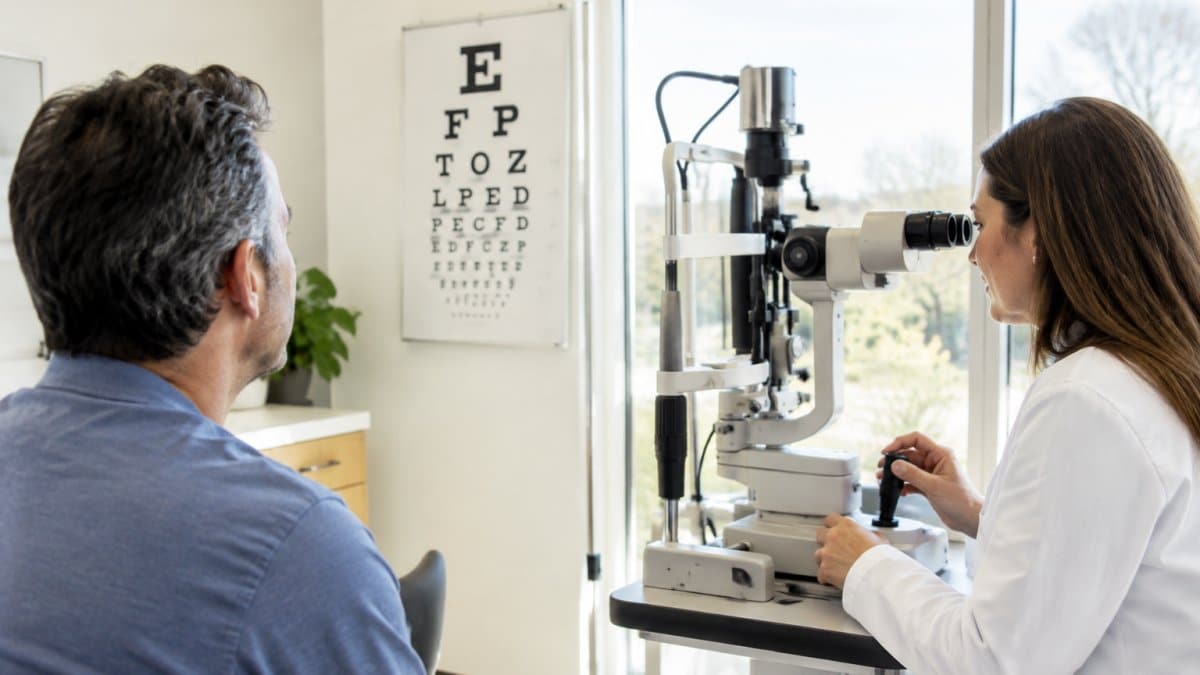
Changes after EVO ICL surgery are generally tied to age rather than to the lens itself. The implant keeps doing its refractive job, while the eye around it continues to age.
Ages 40 to 45. Presbyopia begins. The natural lens loses elasticity and the muscles that focus it cannot compensate as well. Near vision starts to blur, first in low light and at close distances. This is a change in your natural lens, not in the ICL, and it happens whether or not you had surgery.
Cataracts become more likely with age and may eventually need surgery. The ICL does not prevent this.
A sudden change in one eye is a reason to call your surgeon rather than wait for the next scheduled visit.
Watch out: a sudden drop in vision, new flashes or a curtain over part of your visual field, or eye pain are not part of this normal timeline and warrant prompt evaluation rather than a wait-and-see approach.
Here is how age-related eye changes unfold after EVO ICL implantation.
| Age or event | What happens | Note |
|---|---|---|
| Ages 40 to 45 | Presbyopia begins; near vision starts to blur | Change in natural lens, not the ICL |
| Mid-40s and beyond | Many patients still need reading glasses | Expected, not a failure |
| Later in life | Cataracts become more likely with age | ICL does not prevent cataracts |
| If cataract develops | ICL usually has to come out | Removal is straightforward; implant designed to be explanted |
| Sudden vision change in one eye | Call your surgeon rather than wait | Not part of the normal timeline |
EVO ICL and Presbyopia: When Near Vision Shifts
Presbyopia is the age-related loss of close-up focusing. It is not a complication of ICL surgery. It happens to nearly everyone, with or without an implant. (Source: PubMed Central analysis of EVO ICL outcomes)
This is the point patients ask about most. The ICL corrects distance refractive error, but it does not stop the natural lens from stiffening with age.
A clinical guide from Greenwich Eye on ICL and age-related eye changes notes that ICL does not prevent presbyopia or cataracts. Those may need separate treatment later.
Reading Glasses After ICL Surgery
Many patients still need reading glasses in their mid-40s and beyond. That is expected, not a failure.
Options for near vision include:
- Over-the-counter readers for occasional use
- Prescription reading glasses
- Monovision, where one eye is set for near
- A KAMRA inlay for some eligible patients
If reading glasses are your main concern, ask about these at your evaluation.
EVO ICL and Cataracts: What Happens When the Natural Lens Clouds
A cataract is a clouding of your natural lens. It develops with age, and an EVO ICL does not prevent it. Because the ICL sits in front of your natural lens, a cataract that forms behind it is still a cataract in your own lens, the implant is not the cause.
A few points patients ask about most:
- Does the ICL have to come out? In most cases, yes, the cataract is in the natural lens behind it, and the ICL blocks access. Removal is straightforward because the implant is designed to be explanted.
For a plain-language primer, see our guide to an introduction to cataracts.
The ICL is designed to remain in place long term, but the eye continues to change with age.
EVO ICL Lens Removal or Replacement: Your Options
EVO ICL is a phakic intraocular lens, meaning your natural lens stays in place.
If your prescription changes or a cataract develops, your surgeon may recommend:
- Removing the ICL and replacing it with a different power
- Removing the ICL and performing cataract surgery
- Refractive lens exchange, which replaces the natural lens entirely
Refractive lens exchange can address both distance and near vision needs in the right candidate. Your surgeon will match the option to your eye health and lifestyle.
Age Eligibility and Stable Prescription Requirements
Age is only one factor. A stable prescription matters just as much.
To see how age shapes the options, explore our vision for life overview.
Monitoring Symptoms and Follow-Up Care Over the Years
Long-term eye health depends on regular follow-up, not just the surgery itself.
Attend your scheduled visits. Report any sudden vision change, eye pain, or new floaters promptly.
Regular eye examinations become more important as you enter your 40s and 50s, when presbyopia and cataracts commonly appear. If you are ready to plan your own monitoring, schedule a vision correction consult with our team.
Aging eyes will change, and that is normal. The right plan accounts for it from day one. At Schneider LASIK, we offer customized vision correction based on your age, prescription, and lifestyle, backed by state-of-the-art exam and treatment technology and a team led by Mark Schneider, M.D., named a Top Ophthalmologist seven times by the Consumers Research Council of America. Get started with Schneider LASIK and build a long-term plan for clear vision.
Frequently Asked Questions
Can your vision get worse after EVO ICL surgery?
The EVO ICL corrects your existing refractive error, but it does not freeze your eyes in time. Age-related changes still happen. Presbyopia typically begins in the mid-40s and makes near vision harder, which is why many patients need reading glasses later even with clear distance vision. Cataracts can also develop as the natural lens ages. Neither change means the implant failed. It means your eye is aging normally, and your eye doctor can discuss options such as reading glasses, a lens exchange, or cataract surgery when the time comes.
How long does EVO ICL last, and will it need to be replaced?
The implantable collamer lens is designed to remain in place long term. That said, lens longevity and vision longevity are two different things. The lens itself can stay put for decades while your natural lens continues to age. If a cataract develops later, it may be treated with cataract surgery, and your eye doctor can discuss the options with you.
Can you have cataract surgery after EVO ICL?
Yes. Cataract surgery can be considered after EVO ICL, and your eye doctor can explain how it would be planned for your eyes. If you notice blurring, glare, or fading colors as you get older, tell your eye doctor. Those symptoms can point to a cataract, and an eye examination will confirm what is happening.
Is there an age limit for EVO ICL surgery?
Age is only one factor in surgical candidacy. A consultation with a qualified eye surgeon can explain which factors apply to you. Adults outside the labeled range may still have other options, including refractive lens exchange. A consultation with a qualified eye surgeon is the only way to know which path fits your eyes.