


Last Updated: November 21, 2026
Quick Summary
EVO ICL surgery places a small, flexible implantable collamer lens inside your eye, behind your iris and in front of your natural lens, without removing corneal tissue. Numbing drops are applied, a tiny corneal incision is made, and the folded lens is inserted through an injector and positioned behind your iris. You go home the same day.
- You stay awake during EVO ICL surgery; numbing drops block pain and dilating drops widen your pupil.
- The foldable lens is loaded into an injector and guided through a small corneal incision.
- The surgeon confirms the central port is oriented correctly and the lens sits centered behind the iris.
- Arrange a ride home, skip eye makeup, and have your eye drops ready before you leave.
- Many patients notice clearer vision within a day, though vision can fluctuate for the first week.
Table of Contents
- What the EVO ICL Procedure Involves
- Preoperative Evaluation and Candidacy Checks
- Step-by-Step EVO ICL Surgery Procedure Steps
- What an ICL Surgery Video Shows and What It Leaves Out
- Your EVO ICL Recovery Timeline
- EVO ICL vs LASIK: How the Procedures Differ
- Schedule Your EVO ICL Consultation
- Frequently Asked Questions
What the EVO ICL Procedure Involves
EVO ICL surgery is a procedure that places a small, flexible lens inside your eye, behind your iris and in front of your natural lens.
The lens is called an implantable collamer lens. It is made from a soft, biocompatible material that your eye tolerates well. Many patients ask how EVO ICL surgery procedure steps compare to laser surgery.
Here is the short version of what happens:
- You arrive for an outpatient visit.
- Numbing drops are placed in your eye.
- The surgeon makes a tiny incision.
- The lens is folded, inserted, and positioned behind your iris.
- You go home the same day.
The surgery itself is short, though the full visit takes longer once check-in and preparation are included.
The Implantable Collamer Lens and Its Central Port
The EVO lens has a small opening in its center called a central port (The Implantable Collamer Lens with a central port: review of the literature). This port lets fluid flow naturally between the front and back of your eye.
The lens stays in place permanently, but a surgeon can remove it if needed. A review of ICL procedure planning approaches notes that surgeons plan and size these lenses carefully for each eye.
Preoperative Evaluation and Candidacy Checks
Candidacy for EVO ICL depends on your prescription, eye health, and eye structure. A comprehensive eye exam comes first. Your surgeon measures your eyes and checks whether the lens will fit safely.
Expect these tests:
- Corneal measurements to map the shape and thickness of your cornea
- Anterior chamber depth to confirm there is room for the lens
- Eye pressure checks
- Pupil dilation so the surgeon can see the back of your eye
- A full refractive error measurement
Good candidacy usually means stable vision, a healthy cornea, and enough space inside the eye. Our guide on how to choose the best vision correction procedure walks through those choices. Patients who are not LASIK candidates sometimes explore refractive lens exchange instead.
Step-by-Step EVO ICL Surgery Procedure Steps
The EVO ICL surgery procedure steps follow a clear order. Each stage is planned in advance, and your surgeon checks the plan against your eye measurements before starting.
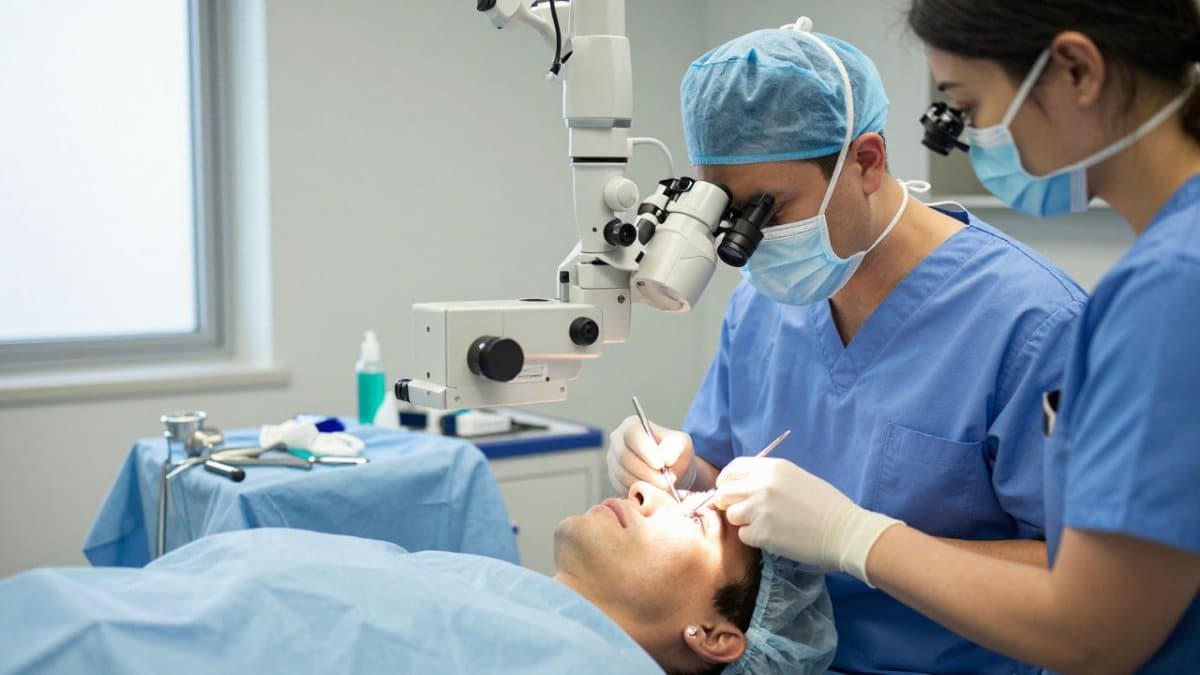
Step 1: Numbing Drops and Dilation
You stay awake the whole time. If you are wondering is laser eye surgery painful, the numbing drops used here are designed to block pain. Numbing drops block pain, and an anesthetic may be used for comfort.
What you may notice: cool drops, a widening blur, and the room dimming as your pupil opens. Most patients describe this stage as the least eventful part of the visit.
Step 2: Sterile Setup and Eye Prep
Your eye area is cleaned and draped in a sterile operating room. A lid speculum gently holds your eyelids open so you do not have to worry about blinking. You will feel light pressure around the eye and hear the room’s equipment and staff moving around you.
What you may notice: pressure from the speculum, the sensation of drapes on your face, and the bright surgical microscope light above you. The light can feel intense, but it does not hurt.
Step 3: The Corneal Incision
The surgeon makes a small corneal incision at the edge of the cornea, where it heals well. This is the surgeon’s main access point. You may feel a brief pressure sensation, and your vision may go momentarily dark or hazy as the microscope light shifts.
What you may notice: a short pressure wave rather than sharp pain. Many patients say the incision stage passes faster than they expected.
Step 4: Lens Insertion Through the Injector
The foldable lens is loaded into an injector and guided through the incision. Because the lens is soft, it folds to pass through the small opening and then opens inside the eye. You may see the light change or notice a shadow moving across your vision as the lens unfolds.
What you may notice: shifting light, a sense of movement, and sometimes a brief pressure increase. The injector itself is not visible to you.
Step 5: Positioning Behind the Iris
The surgeon guides the lens behind the iris and in front of your natural lens. Correct lens positioning matters: the lens must sit centered and clear of the pupil.
What you may notice: the light settling and your vision beginning to clear as the lens is positioned.
Watch out: if you feel sudden sharp pain or a strong pressure spike, tell your surgeon immediately so the team can adjust.
Step 6: Check and Discharge
The surgeon confirms placement, then you rest briefly before going home. You leave the same day with postoperative instructions and eye drops. Your vision will be blurry at first, and you may notice light sensitivity, halos, or glare early on.
What you may notice: blurry but improving vision, a gritty feeling, and the desire to rest. Most patients are ready to go home within a short recovery period.
How the EVO Lens Design Affects the Steps
The EVO lens has a small opening in its center called a central port. This port lets fluid flow naturally between the front and back of your eye. That flow helps keep pressure balanced without extra surgical steps. Your surgeon still checks pressure and positioning after insertion, because the port is one part of a safe fit, not a substitute for careful sizing.
Why the Steps Can Vary
The sequence above is typical, but the plan can change for several reasons:
- Differences between eyes. Your two eyes may need different lens sizes or slightly different incision locations.
- Anesthesia approach. Some surgeons use additional numbing or a mild sedative, while others rely on drops alone.
- Unexpected findings. If measurements during surgery suggest a different lens or a change in plan, your surgeon may pause, adjust, or reschedule.
- Positioning checks. If the lens does not sit as planned, the surgeon may reposition it or choose a different approach.
A common pattern is for the second eye to follow a similar sequence a short time after the first, once the first eye has been checked. Your surgeon will confirm the timing based on how your first eye responds.
What an ICL Surgery Video Shows and What It Leaves Out
An ICL surgery video shows the incision, the injector, and the lens unfolding. What it rarely shows is the planning behind it, the measurements, and the checks your surgeon runs before and after insertion. Videos also skip the calm, quiet reality. Most patients lie still and listen to the room. Some feel mild pressure. Few describe it as painful.
What Videos Capture Well
- The order of the steps, from numbing drops to lens positioning
- How small the incision is relative to the eye
- How the foldable lens opens once inside the eye
- The general pace of the procedure
What Videos Leave Out
- The preoperative measurements. Your candidacy depends on corneal measurements, anterior chamber depth, and a full refractive error measurement. None of that appears on screen.
- The safety checks. Videos rarely show the surgeon confirming lens orientation, checking the central port, or assessing pressure after insertion.
- The sensory experience. You will not see the pressure sensations, the microscope light, or the sounds of the room.
- The decision points. If the plan changes mid-procedure, the video does not explain why.
A Day-of-Surgery Checklist
Use this checklist to prepare for the practical side of the visit:
- Transportation. Arrange a ride home; you will not be able to drive yourself.
- Medications. Tell your surgeon about all medications and follow any instructions about which to pause.
- Arrival. Plan to arrive early for check-in and final measurements.
- Comfort. Wear comfortable clothing and skip eye makeup on the day of surgery.
- Aftercare. Have your eye drops and postoperative instructions ready before you leave.
Use videos to understand the sequence, not to judge your own case. Your eye measurements decide the plan.
Your EVO ICL Recovery Timeline
The EVO ICL recovery timeline is usually short. Many patients notice clearer vision within a day. Vision can fluctuate for the first week as your eye adjusts.
A typical pattern looks like this:
| Timeframe | What to Expect |
|---|---|
| Day of surgery | Blurry vision, mild light sensitivity |
| First few days | Vision settles, eye drops begin |
| First week | Most daily tasks feel normal |
| Follow-up visits | Surgeon checks pressure and lens position |
| First month | Vision stabilizes for most patients |
Light sensitivity, halos, and glare can appear early and often fade. Use your eye drops as directed and attend every follow-up examination. Our tips for faster recovery after eye surgery cover practical steps for the first week.
Watch out: skipping follow-up visits can hide a rise in intraocular pressure before you notice symptoms.
EVO ICL vs LASIK: How the Procedures Differ
The choice between EVO ICL vs LASIK comes down to your cornea and your prescription. LASIK reshapes the cornea with a laser. EVO ICL leaves the cornea intact and adds a lens.
| Factor | EVO ICL | LASIK |
|---|---|---|
| Corneal tissue | Kept intact | Reshaped |
| Reversible | Yes, lens can be removed | No |
| Best for | Thin corneas, higher prescriptions | Suitable corneas, lower prescriptions |
| Procedure time | Short, per eye | Short, per eye |
Neither option is right for everyone. Your candidacy depends on your prescription, corneal measurements, and eye health. A single-center study of EVO/EVO+ ICL outcomes examined refractive results for this lens as an alternative to laser vision correction.
Schedule Your EVO ICL Consultation
Choosing a procedure starts with knowing your own eyes. A consultation gives you real answers about candidacy, risks, and timing.
Schneider LASIK offers EVO ICL, LASIK, PRK, and refractive lens exchange. Treatment plans are customized to your age, prescription, and lifestyle.
Schneider LASIK offers a free trial consultation. Request a consultation to find out whether EVO ICL fits your eyes.
If you are tired of glasses and contacts, the next step is a conversation, not a commitment.
Frequently Asked Questions
How long does the EVO ICL surgery procedure take?
The procedure is performed as an outpatient procedure with same-day discharge. Your surgeon will confirm the timing for each eye based on how the first eye responds. Plan for a longer visit overall once you include check-in, numbing drops, pupil dilation, and a short observation period before you go home.
Are you awake during EVO ICL surgery, and what will you feel?
You are awake, but numbing drops and a mild anesthetic keep the eye comfortable, so you should not feel pain. You may notice pressure, light sensitivity, and the sense of movement around the eye. Your surgical team will explain each stage so you know what is happening.
How soon can you see clearly after EVO ICL surgery?
Vision typically settles over the following days and weeks, and your surgeon will advise on your individual recovery. Blurriness, halos, glare, and light sensitivity are common early on and usually ease over the first few weeks. Your EVO ICL recovery timeline includes follow-up examinations to check visual acuity and eye pressure. Your surgeon will tell you when it is safe to drive, return to work, and resume swimming or contact sports.
What is the difference between EVO ICL vs LASIK?
LASIK reshapes the cornea with a laser, while EVO ICL adds a foldable implantable collamer lens behind the iris without removing corneal tissue. The lens is made of a biocompatible material and can be removed by a surgeon, which is why it is sometimes described as reversible. EVO ICL is often considered for higher prescriptions or thin corneas, while LASIK suits many lower prescriptions. A comprehensive eye exam with corneal measurements determines which option fits your eyes.